You guys.
I have been sitting on this recipe for a month and a half because it took me eight batches to nail down, and also because I needed to fully recover from what my nephew Brayden put me through to earn the story. But we are here now. The Potion of Night Vision — or as I now call it, The Caver’s Draught — is real, it is genuinely magical, and the first time I lifted the finished flask up to the kitchen window and watched the gold leaf drift through the blue, I said “oh” out loud to an empty room.
Let me explain.
The Setup
You already know Brayden. Twelve years old. Competitive gamer. Holder of the family record for Most Condescending Sentence Ever Spoken to an Adult (“Aunt Maggie, do you even know what shaders are”). I was still winded from the Slurp Juice trip when he cornered me at Sunday dinner three weeks ago with the specific look of a child about to change your life whether you want him to or not.
“You need to come to my world,” he said, forking stuffing into his mouth. “Not the Slurp one. My other one. The main one.”
“What’s the main one?”
He paused. Fork halfway to his mouth. He looked at Mark. He looked at his mother. He looked back at me with the infinite patience of a child explaining something nobody should have to explain.
“Minecraft, Aunt Maggie.”
Here’s what you need to understand about Brayden and Minecraft specifically — not Brayden and games in general, because that’s a separate essay. Brayden’s Minecraft world is four years old. He has been building in it since he was eight. He has a villager trading hall. He has a fully-enchanted netherite kit. He has something he calls a nautilus farm, which he explained to me twice and which I still could not explain back to you under oath. He talks about this world the way my friend Terrence (the astrophysicist, eleven-time Hitchhiker’s rereader) talks about the early universe — total immersion, total seriousness, zero awareness that the person across the table is tracking maybe forty percent of what he’s saying.
Mark set down the dish towel very slowly when I told him I’d agreed to go. “You’re going to Minecraft.”
“With Brayden.”
“Magnolia. You don’t know what a nautilus farm is.”
“I know now, Mark. I know now.”
He gave me the specific look he gives me before trips — not worried exactly, more like cataloguing the ways I might come back different. “Pack a jacket,” he said finally. “I don’t know why. I just feel like you should pack a jacket.”
I packed a jacket.
The Journey
Brayden’s world. Let me paint you a picture.
You know how some places look exactly the way you expected them to look, and some places don’t? This was the first kind. Blocks. Actual, literal, square blocks — grass on top, dirt on the bottom, stone underneath. A sun the size and sincerity of a child’s drawing. A river that flowed in rectangles. Sheep that were, themselves, cubes. I spent the first ten minutes just turning in circles because every direction looked more charming than the last.
“Aunt Maggie. Aunt Maggie. We need to move.”
To his credit, Brayden is a patient guide when he’s in tutorial mode. He set me up with a starter kit — a wooden pickaxe, a small stack of bread, a leather jacket (vindicated, Mark, thank you) — and started leading me through. A cobblestone path. Past his house, which was objectively enormous and which he referred to, without irony, as his “starter base.” Past a pen of pink pigs who all stared at me with the exact same expression. Past a small lake where a squid floated near the surface, squidding peacefully.
“Where are we going?”
“The swamp.”
“Why are we going to the swamp?”
“Because you need a Potion of Night Vision if you’re going to help me clear the Deep Dark.”
“I don’t know what the Deep Dark is.”
“I know you don’t. Keep walking.”
The walk took — and this is true — approximately six in-game days. I know this because Brayden announced it every time the sun came up. (“Day 3, Aunt Maggie, eat bread.”) We crossed a plains biome. We skirted a mountain that he told me not to climb for reasons he refused to explain. We forded a river. We were chased for about forty seconds by a single wolf, which Brayden then fed a bone to, after which it became the most loyal creature I have ever encountered. I named him Dale. Brayden said, “His name is not Dale, Aunt Maggie, he’s not tagged.” I said his name was Dale. Dale walked behind us for the next two days. His name is Dale.
The swamp showed up at dusk. And look — in Minecraft, dusk is not a subtle transition. The sky just starts going apricot-pink-orange in a very specific, deliberate way, and the water turns that particular shade of sick-green that swamps apparently are, and the bugs — I think they were bugs, they were pixels, they were small pixelated points of light — started to swarm above the reeds. Frogs, huge frogs, bigger than I expected, a sort of dignified olive-brown with calm eyes, hopped between lily pads. The whole biome smelled like — okay, I know a swamp in a game can’t smell like anything, but I am telling you, it smelled like wet moss and old wood and something faintly medicinal, like dried herbs hung from a pantry ceiling.
The witch hut sat on stilts at the edge of a shallow inlet, slanted slightly to one side the way old cabins slant when they’ve been standing a long time in wet ground. A single lantern hung from the porch. The windows glowed purple.
“Okay,” Brayden said, pulling on my sleeve. “This is Thistle’s place. She’s chill. Don’t stare at the cat.”
“Why can’t I stare at the cat?”
“You just shouldn’t. It’s rude.”
Thistle answered the door on the second knock. She was — and I’m saying this with affection — exactly what you’d expect a swamp witch to look like if you asked a child to draw one, which I suppose is more or less what someone did. Pointed black hat slightly dented at the crown. Purple robes over a grey dress. A nose with a truly iconic wart on it, set right at the very end in the place where noses have their most photogenic angle. Her expression said I am delighted to see you and also I might poison you, it depends on how the next three minutes go.
“You brought me the aunt,” she said to Brayden.
“She needs Night Vision.”
“And payment?”
Brayden pulled a small pouch out of his inventory (do not ask me to explain; I do not know) and handed it to her. I suspect it was emeralds. I suspect I will find out by means of a retroactive IOU at some future Thanksgiving.
The inside of the hut was smaller than I expected and so much warmer. A fire crackled in a stone hearth. A black cat — at whom I did not stare — sat on a small rug licking its paw in the unbothered way cats have. And in the back corner, sitting on a rough-hewn wooden bench, was the thing I had come to see: a brewing stand. Three tall glass bottles, each bubbling independently at its own slow rhythm, arrayed around a central pillar of blackstone. Blaze powder glowed at the base, pulsing orange.
“First time with a stand?” Thistle asked, not looking.
“That obvious?”
“You’re making the face.”
She moved through the brewing the way my mother makes pancakes — so without thinking that it made me feel like I was watching muscle memory, not magic. A water bottle went into the stand. A pinch of Nether wart from a small clay dish. The three bottles turned from clear to a murky, foggy pink-grey. “Awkward Potion,” Thistle said. “Base layer. Doesn’t do anything on its own. Can’t get anywhere without it.”
Then the key ingredient. She reached up to a shelf and took down a single ordinary carrot. Real. Familiar. Then, from a small velvet bag, she took out eight tiny nuggets of gold, arranged them around the carrot on a crafting square with the deliberate slowness of someone doing a trick she’s done ten thousand times, and tapped the surface once. The carrot came up gold. Not dipped in gold. Gold. Glowing.
“Golden Carrot,” Brayden whispered beside me, reverently. “This is where it gets cool.”
She dropped the carrot into the stand.
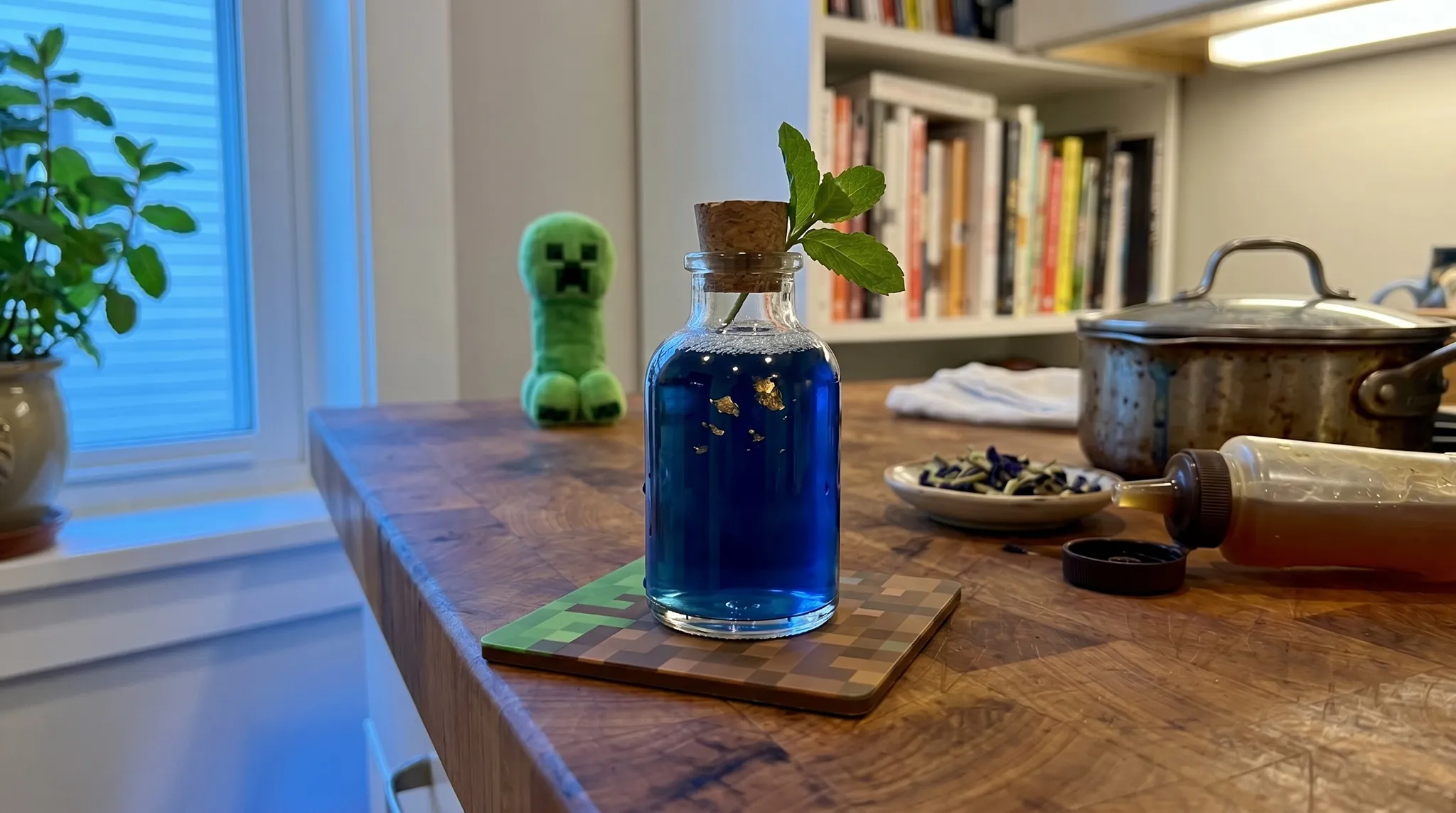
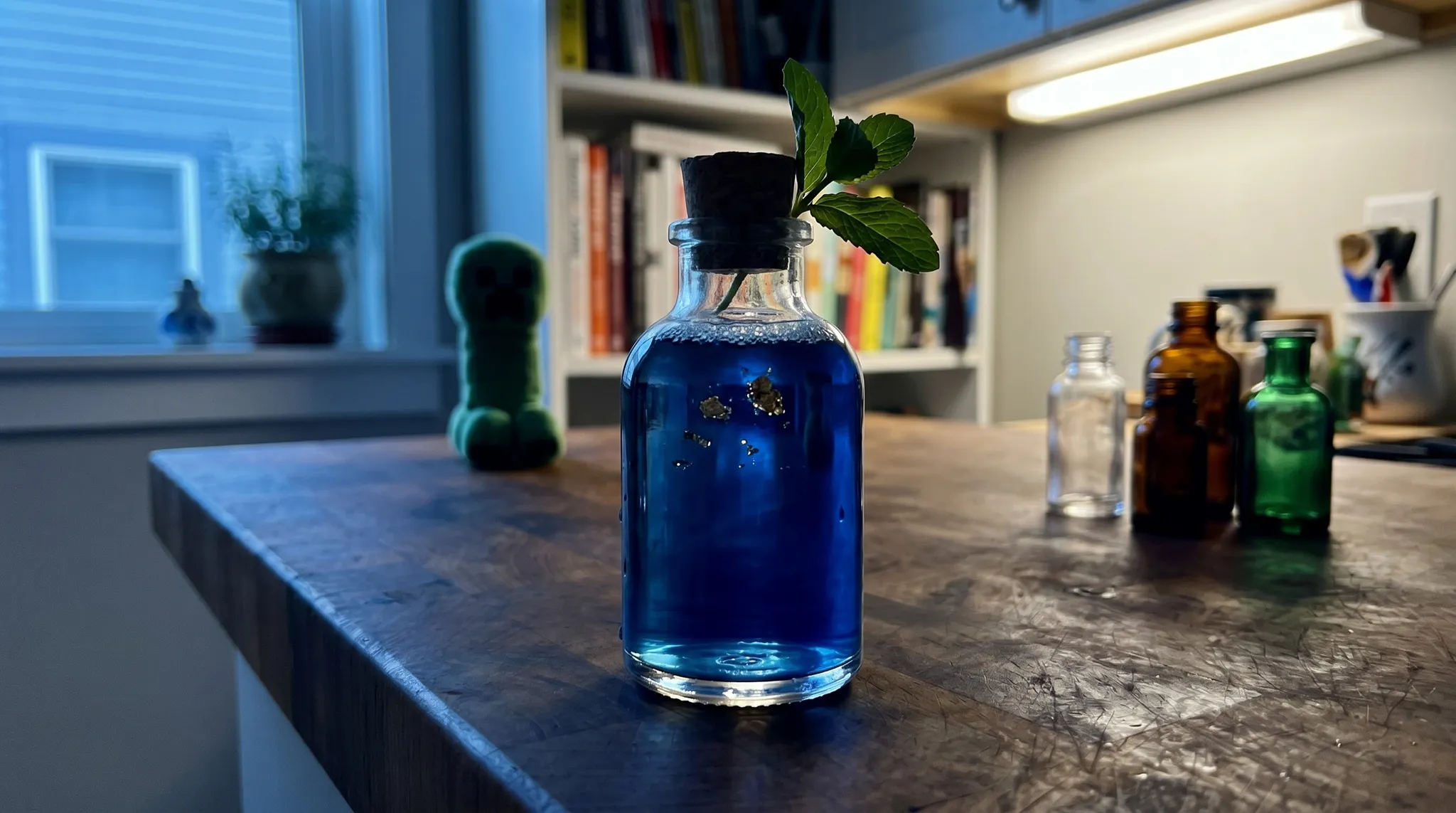
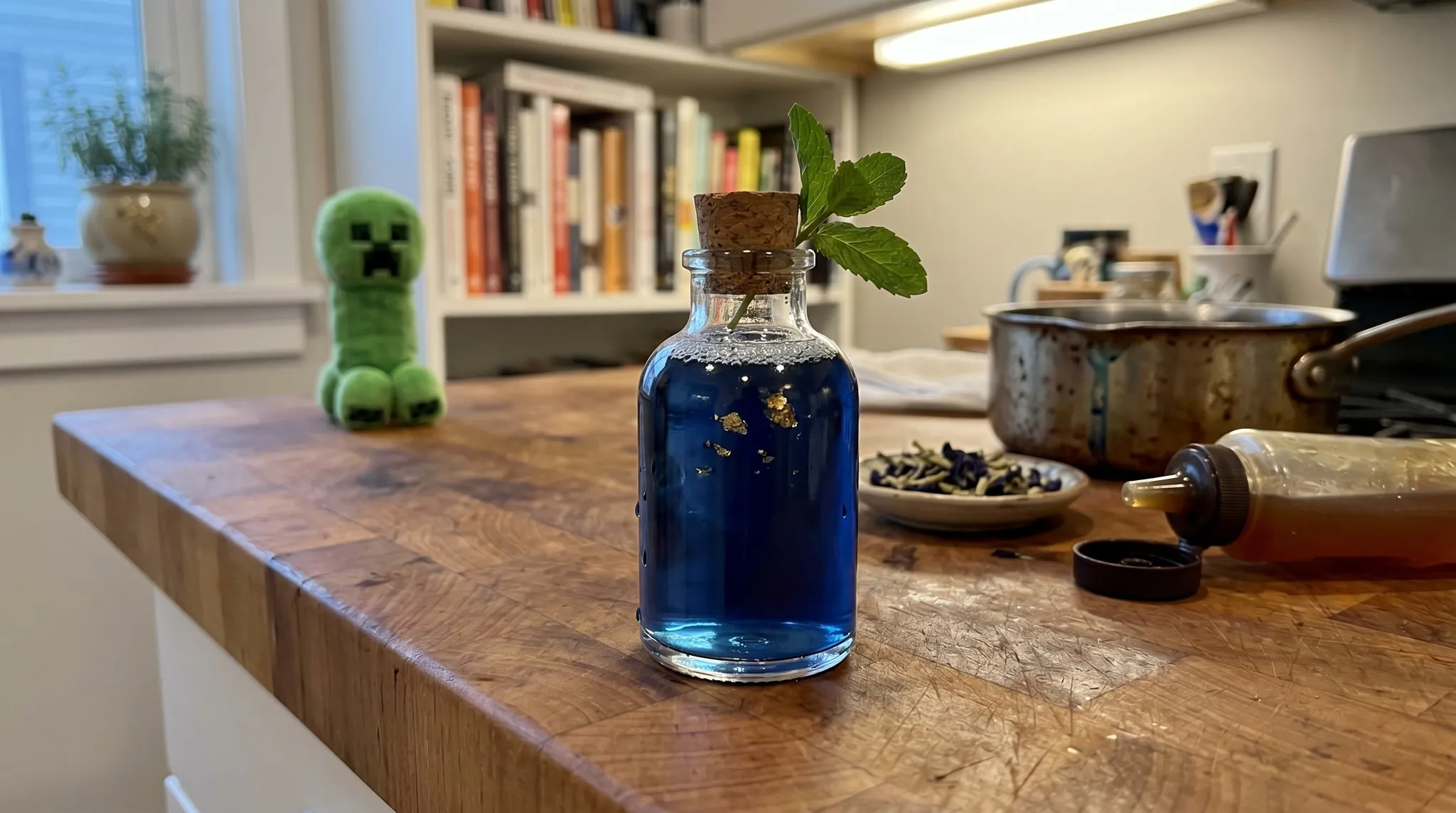
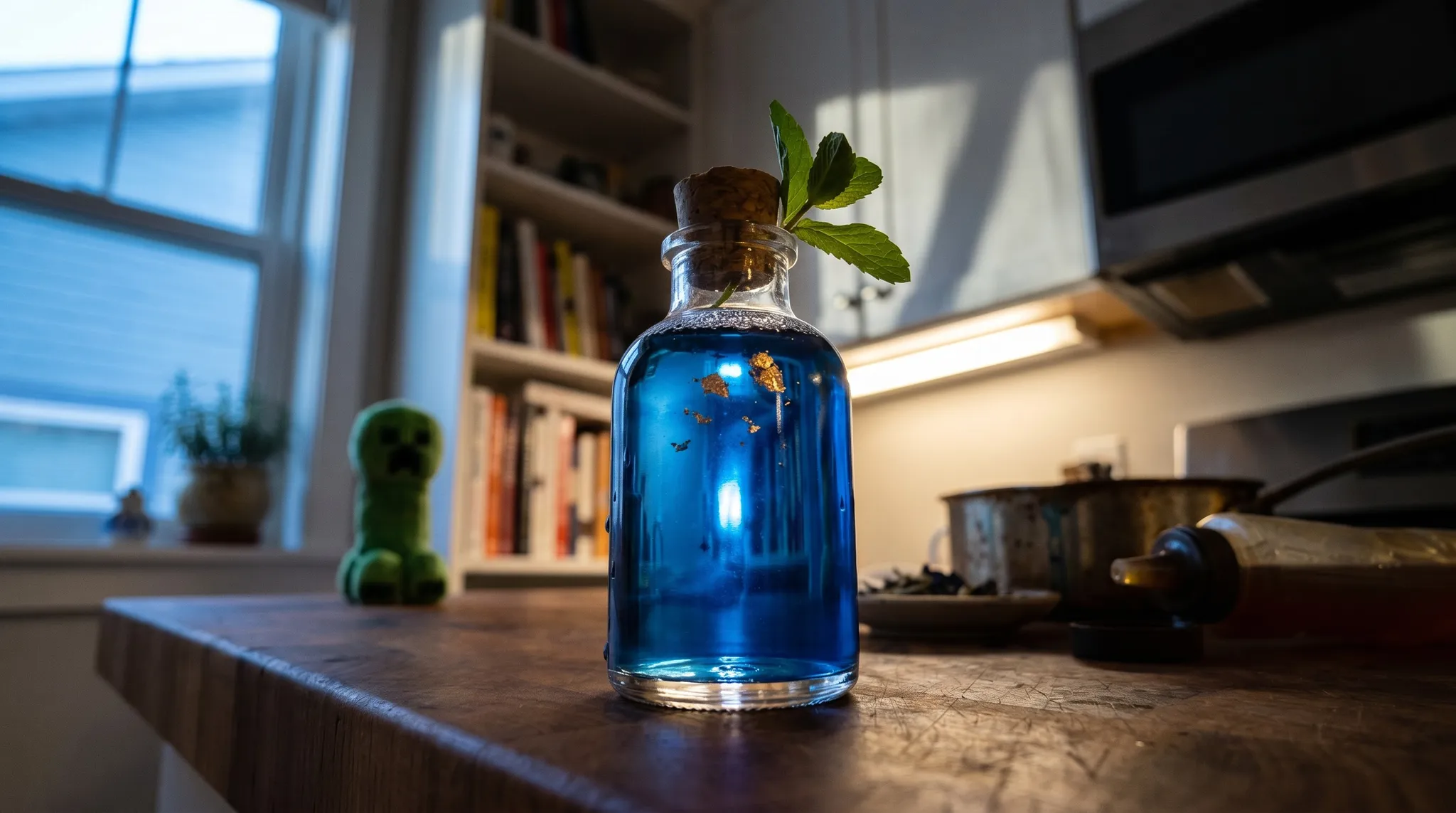
The bottles fogged. Hissed. Went clear. And then — this is the part I want you to picture, and I want you to trust me about how it looked, because I have been trying to replicate this color for six weeks — they bloomed blue. Not any blue. A deep, slow, dusk-sky, right-before-the-stars blue. The blue at the bottom of a well. The blue of a candle flame if candle flames were blue. It glowed from inside the bottle in a way that seemed to know it was being watched.
“Night Vision,” Thistle said, and handed me a bottle.
The Moment
I need to pause and tell you something. I have had a lot of first sips on this blog. The first sip of Romulan Ale at Quark’s. The first sip of the Drink of Despair in the cave. The first sip of Estus Flask at Firelink, which I will carry with me until I am dust.
This one was different.
This one, I want to describe correctly, because the sensation was not in my mouth. The sensation was in my eyes.
The potion itself tasted roughly the way you’d expect a slightly herbal, slightly sweet, faintly carroty drink to taste. Thistle had done something with honey and ginger that mellowed the earthy bitterness of the Nether wart base, and the golden carrot came through on the finish as this soft, almost-mulled-cider warmth. Fine. Delicious. Not the point.
The point was that the room got lighter.
Not literally brighter — the candles didn’t flare, the fire didn’t jump. But the dim, flickering, shadow-soft corners of the hut, which had been blurred at the edges, became readable. I could see the grain on the wooden bench in the back. I could see the labels on every jar on Thistle’s shelf. I could see the dust motes drifting in the air above the hearth, each one a small visible speck. It was as if someone had turned up the ambient brightness of reality without touching any of the actual light sources.
I walked outside. The swamp at night, which had been a flat purple wash from the porch fifteen minutes earlier, was — I am sorry, there is no non-corny way to say this — alive. I could see individual reeds bending in the breeze. I could see a pair of slimes wobbling peacefully through a clearing sixty blocks away. I could see the specific, unamused expression of the frog who had been watching me from a lily pad the whole time.
Brayden came up beside me. He couldn’t drink the potion — witch’s rules, he said, don’t ask — but he had a pair of goggles on that I don’t remember him putting on.
“You see everything now?”
“Yes.”
“Cool, right?”
I felt like I was going to cry a little bit, Dear Reader, and I would like to tell you it was about the frog, but it was actually about my nephew, who is twelve, who spent four years building this world so that he could show it to his aunt, and who chose this specific spot to bring me to, so I could see what he sees when he plays.
“Yeah,” I said. “It’s cool.”
Thistle, who had come up behind us, patted my shoulder with a hand that was, I will admit, a little colder than a human hand should be.
“Come back in spring,” she said. “The fireflies are better then.”
Back in My Kitchen
Okay. Let’s talk about how to make this.
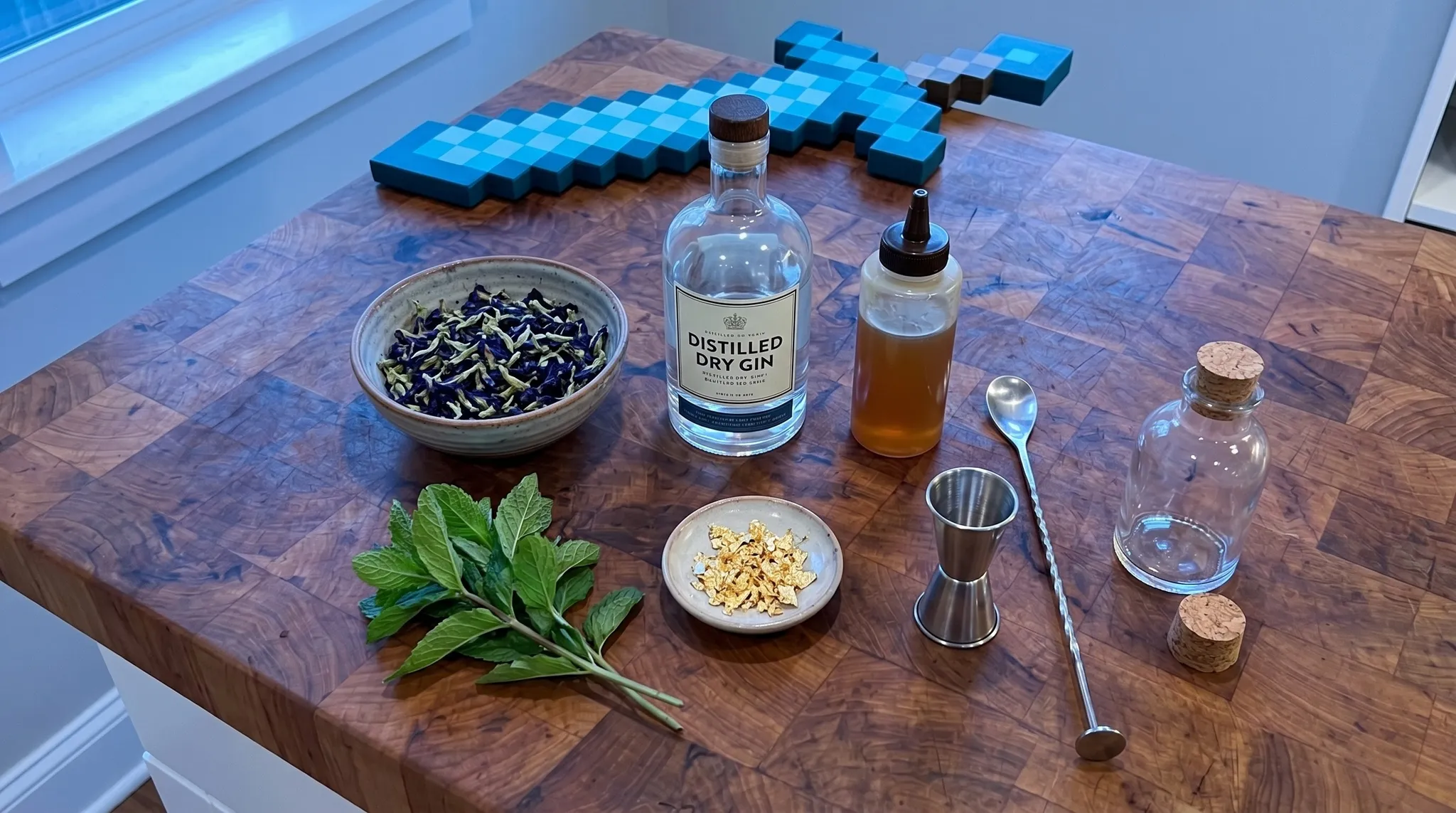
The first thing I want to tell you is that I tried very hard to replicate the sensation of the drink and the sensation of the drink is a sensation no cocktail ingredient on Earth can provide, so at a certain point I gave up and focused on the look and the feel. This is going to be a very, very blue drink, and the way you know you’ve gotten it right is the moment you finish pouring, hold the bottle up to the light, and go “…oh.”
Here’s what didn’t work.
Batch one was blue curaçao alone, over gin, with tonic. It was the color of an airport lavatory and tasted roughly the same. I rinsed the glass into the sink and watched the blue spiral down the drain and briefly questioned every choice that had led me to my kitchen at 11:47 PM on a Tuesday.
Batch two was a blueberry puree, because my brain in the 11:48 PM hours is not a brain that makes good decisions. The color was wrong (purple, muddy, dead-grape) and the flavor was wrong (blueberry muffin, not mysterious witch) and I threw out a quarter-cup of very expensive fresh blueberry puree and went to bed.
Batch three was the breakthrough. I’d been reading about butterfly pea flower — the dried blue blossoms they use in Thai cooking to color rice a regal indigo — and I made a very strong cold steep. Eight grams of dried petals in a cup of cold-filtered water, overnight in the fridge. When I pulled the jar out the next morning I actually gasped. That was the blue. That was the specific blue. That was the color I had seen bloom in the brewing stand, bottled and waiting in my fridge.
From there it was a matter of building the cocktail around the tea and not around the curaçao. Butterfly pea is delicate — it wants a clean, dry gin, not a botanical hurricane — so I went with Hendrick’s. Any rose-and-cucumber-forward gin works, but don’t use a heavy juniper like Tanqueray or you’ll flatten the color. A half ounce of blue curaçao, not a full ounce, because its job here is saturation, not color. Honey-ginger syrup to echo the warmth of the golden carrot. Orange bitters because Thistle’s version had that mellow-carroty finish and orange bitters are the closest thing to carrot on Earth (this is a small hill I am willing to die on). A pinch of salt. Tonic to top.
And then — and this is the part I want you to not skip past — edible 24k gold leaf flakes. I want to be very clear about why this is not a decorative flourish. In Minecraft, the Potion of Night Vision cannot be brewed without a Golden Carrot. The gold is not optional. It is not a garnish. It is the thing that turns the brew from nothing into a potion. So when you scatter those little flakes across the top of your bottle and they drift through the tonic bubbles and catch the light — that is not a gimmick. That is the translation. I tried it without the flakes and it was fine. I tried it with the flakes, looked at the bottle, and said “oh” the way I had the first time. Trust me.
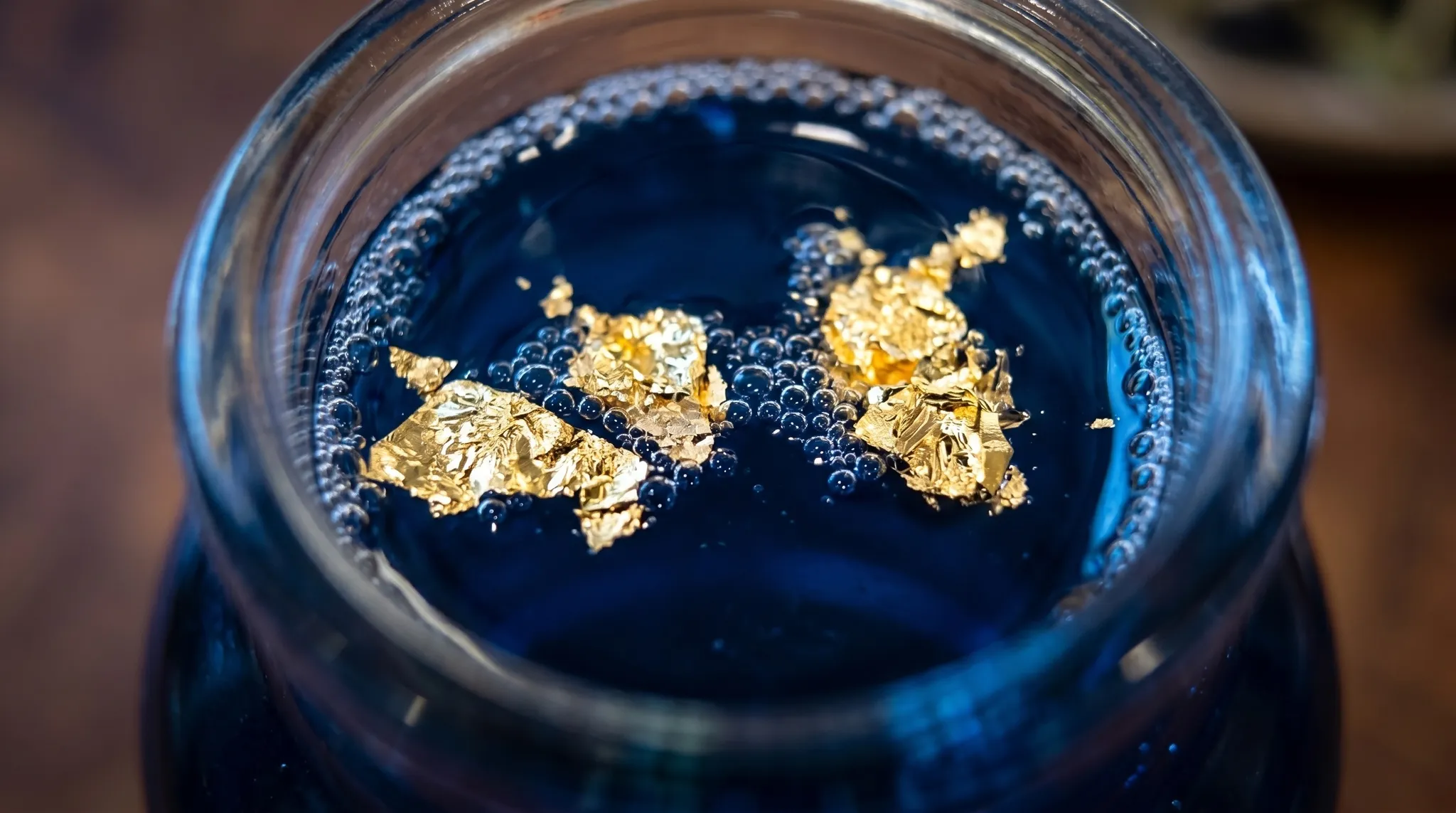
A note on vessel. Serve this in a small corked apothecary flask, the kind you can find at any reasonable kitchenware store for about eight dollars — six ounces, flip-top cork. Do not serve it in a coupe. Do not serve it in a rocks glass. If all you have is a mason jar, the mason jar is fine and honestly a little homestead-Minecraft in its own right, but the flask is the canonical vessel and canonical matters.
The one technical note that matters more than I thought it would: do not add any acid to this drink. Butterfly pea tea is pH-reactive — a squeeze of lemon will turn it bright fuchsia, which is beautiful, and wrong. If your water is hard you’ll get a richer, truer blue by default. If your water is soft or acidic, compensate with a tiny pinch of baking soda in the tea while it cold-steeps. Tinier than you think. You are not baking bread.
Making It Yours
Make this for your nephew the next time he dares you into one of his worlds. Make it for yourself on a Thursday because you’ve had a long week and you want to drink something that looks like it came out of a children’s book but tastes like an adult knew what she was doing. Make it — and I cannot stress this enough — with the little gold flakes. Don’t skip them. They are the whole point.
If you want to skip the tonic and pour it denser and more concentrated, you can — cuts the total volume to about four ounces, which is honestly the more Thistle-appropriate pour.
If you make this, send me a picture. Tag me. I want to see your flask. I want to see the specific pixel of light that catches on the gold leaf. And if Brayden asks — I still don’t know what a nautilus farm is.
The Caver's Draught (Potion of Night Vision)
Ingredients
For the butterfly pea tea (make the night before)
For the cocktail
For the honey-ginger syrup (makes about 1 cup)
Instructions
- Cold-steep the butterfly pea tea the night before. Combine petals, cold water, and the baking soda (if using) in a jar, stir gently, refrigerate at least 8 hours (12 is better). Strain before using. The color should make you gasp. If it doesn't, steep longer or add more petals.
- Make the syrup. Whisk honey, hot water, and ginger slices in a small saucepan over low heat until the honey is fully dissolved. Cool to room temperature, then strain out the ginger. Keeps in the fridge for two weeks. You will find uses for it.
- Combine the gin, butterfly pea tea, blue curaçao, honey-ginger syrup, orange bitters, and salt in a mixing glass with plenty of ice.
- Stir, don't shake, for 30 seconds. Long for dilution, long for chill, long for clarity. Shaking aerates the butterfly pea and dulls the blue. Stir. Thistle stirs. You stir.
- Strain into a 6-ounce corked apothecary flask, leaving about an inch of headspace for the tonic. Set the flask down on the counter for a moment and admire it — you've earned it.
- Top gently with cold tonic water. Let the bubbles do what bubbles do.
- Float a small pinch of edible 24k gold leaf flakes across the surface. They will catch on the bubbles and drift. This is the golden carrot. This is the whole recipe's thesis.
- Garnish with a small sprig of mint tucked beside the cork. Cork the flask. Serve immediately — the tonic bubbles are prettiest in the first two minutes.
Magnolia’s Notes
-
On the tea: Eight grams is my working number, but butterfly pea flower varies wildly by vintage and supplier. I buy mine in bulk from a Thai grocery in Denver (dried, sealed, stored in a glass jar away from light) and the color is consistently deep. Online, Tea and Whisk and Harney & Sons both do a respectable bag. Steep cold, not hot — hot steeping can muddy the blue and introduces a weird grassiness that ruins the whole point. If you can plan ahead and steep for twelve hours instead of eight, do.
-
On the gin: Hendrick’s is my go-to because the cucumber-and-rose profile is already so clean that it doesn’t fight the tea. Other good picks: The Botanist (floral-forward), Sipsmith (restrained), Empress 1908 if you want to reinforce the indigo and don’t mind the drink leaning a little darker. Do not use a heavy juniper gin like Tanqueray or Beefeater — the juniper hulks up and flattens the blue into something muddier and less magical.
-
On acid: There is no acid in this cocktail and that is intentional. Butterfly pea tea shifts from blue to purple to fuchsia as pH drops, and the Potion of Night Vision is blue. Lemon, lime, vinegar, verjus — all of them will undo your work. If you want to see the color shift as a parlor trick, pour a teaspoon of the finished drink into a separate glass and add a squeeze of lemon. Leave the primary flask untouched.
-
On the gold leaf: Use real edible 24k gold leaf, not “edible gold glitter” or “gold dust.” Glitter is plastic and will float wrong; dust dissolves and muddies the color. Gold leaf flakes (sometimes sold as “transfer flakes” or “loose flakes”) are thin enough to drift on the surface tension and bright enough to catch the smallest amount of light. A pinch per flask is plenty. Keep the rest in its sealed tin — it lasts forever.
-
On the vessel: A small corked apothecary flask (6–8 oz, flip-top cork or a real cork stopper) is the canonical vessel and I will not be negotiated out of this. If you absolutely cannot get one, a small swing-top bottle is the next best thing. A coupe is wrong — you lose the potion-bottle silhouette, which is the visual joke. A mason jar is charming in a different, more rural-homestead-Minecraft way, and I will accept it.