You guys. YOU GUYS.
I had my brains smashed out. Not metaphorically. Not partially. I sat at a table at the literal end of the universe and I drank the thing that Douglas Adams once described as “like having your brains smashed out by a slice of lemon wrapped round a large gold brick,” and I am here to tell you that he was — characteristically, beautifully, maddeningly — underselling it.
I have been sitting on this recipe for six weeks because every time I tried to write this post I would get to the part about the first sip and my hands would start shaking and I’d have to go lie down on the kitchen floor for a while. Mark found me there twice. The second time he just stepped over me and made coffee. We’ve been married long enough that he knows when to ask questions and when to simply not.
But I’m ready now. I think. Let me explain.
The Story
My friend Terrence is an astrophysicist. I need you to understand what this means in practical terms: it means that he has read The Hitchhiker’s Guide to the Galaxy eleven times — he keeps count, he keeps a tally in the back cover of his paperback, which is held together with tape and something that might be hope — and it means that when he calls you at nine o’clock on a Saturday morning while you’re still in your bathrobe eating cereal over the sink, the thing he’s calling about is going to be either extremely boring or extremely dangerous, with no middle ground.
“Magnolia,” he said. “I got us a reservation.”
I put down my spoon. I was eating Honey Nut Cheerios, which is relevant to nothing except that I want you to know the exact texture of the morning this started in. Mundane. Crunchy. Slightly too much milk.
“A reservation where, Terrence.”
“Milliways.”
I almost dropped the bowl. Milliways. The Milliways. The Restaurant at the End of the Universe. The most exclusive dining establishment in the history of time itself, located at the precise temporal coordinates where the universe stops existing, where you can eat a lovely meal and watch all of reality collapse into nothing while someone plays soft piano music. I’d heard about it the way you hear about anything impossibly exclusive — through whispers, through friends of friends, through Terrence, who had been trying to get a table for three years and had once described the waiting list as “longer than entropy.”
“How?” I asked.
“A colleague of mine did some consulting work on their temporal stabilization array. He owed me a favor.”
“Terrence, I’m in my bathrobe.”
“The reservation is for next Saturday.”
I should tell you about the week that followed, because it was one of the most absurd weeks of my life, and I include the week I accidentally ended up at a Khajiit caravan and drank something that made my eyes glow. I had nothing to wear. I don’t mean that in the casual, throw-it-out-at-brunch way — I mean I had nothing to wear to the end of the universe. What is the dress code for watching reality dissolve? Smart casual? Black tie? Is there a “heat death chic” I should be aware of? I spent two hours at a department store on Tuesday, standing in front of a rack of dresses, holding a dark green one in one hand and a navy one in the other, paralyzed by the philosophical question of whether it matters what you look like when everything ceases to exist. I bought the green one. It had pockets. If the universe is ending, I want somewhere to put my hands.
Mark drove me to Terrence’s place on Saturday. He’s good about that, Mark. He doesn’t always understand why I do the things I do — he definitely didn’t understand Milliways, he kept asking “but when does the universe end, like, time-wise?” and I kept saying “Terrence says it’s complicated” — but he drops me off and he picks me up and he asks me how it was and he listens to the whole answer even when the answer takes forty-five minutes and involves concepts that don’t obey linear causality. That’s love. I’m fairly sure.
“Text me when you get there,” he said, idling at Terrence’s curb.
“I’m not sure texting works at the end of the universe.”
“Try anyway.”
I kissed him. He tasted like the peppermint gum he chews when he’s nervous for me. Then I got out and walked up Terrence’s driveway in the green dress and a pair of heels that I was already regretting because Terrence’s driveway is gravel and heels on gravel is a war crime against ankles.
Getting to Milliways requires — and I want to be very precise about this — time travel. Terrence handled the logistics. He has a contact who has a contact who has a ship that does temporal jumps, and I did not ask for details because the details, in my experience, only make things more stressful. I sat in a seat that was not designed for someone of my height (I’m 5’4”, and the seat was built for someone who is either 6’2” or has different ideas about what knees are for), and I watched the universe go by outside the window, which sounds romantic but mostly looked like being inside a washing machine filled with light.
“You okay?” Terrence asked. He was reading something on a screen — calculations, probably, or possibly the eleventh-and-a-halfth reading of the Guide.
“I’m fine. Is the universe supposed to look like that?”
“Like what?”
“Like someone is doing laundry with it.”
“That’s just temporal displacement. Your eyes adjust.”
They did not adjust. But we arrived.
Milliways is — okay. I need a moment for this. I need to find the right words and I’m not sure the right words exist in English but I’m going to try.
You arrive and the first thing you see is the sky. Except it isn’t the sky. It is every sky that has ever existed and every sky that will ever exist, layered on top of each other, compressed into a single canopy of light and darkness and color that your brain refuses to process as one image so instead it processes it as a feeling, and the feeling is: oh. Just oh. The kind of oh that you feel in your sternum, not your head. I stood in the entrance vestibule and I said nothing for what Terrence later told me was about ninety seconds, which he said was “actually pretty good, most people cry.”
I did not cry. I came close. The carpet was very soft, which helped.
The restaurant itself is elegant in a way that feels ancient and modern at the same time. The tables are small, intimate, set with glassware that seems to be made from something not quite glass — it catches light in directions that light shouldn’t go. The chairs are comfortable in a way that makes you realize most chairs are lying to you about what comfort means. The lighting is warm and dim and comes from somewhere you can’t identify, which gives the whole room the quality of a memory you’re having while you’re still inside it.
Our waiter was a Magrathean named Pralix. Tall, impossibly composed, with the kind of posture that made me feel like I’d been slouching for thirty-three years straight, which, to be fair, I probably have. He moved between tables with the fluid precision of someone who has served dinner at the end of time so many times that the apocalypse is just Tuesday.
“Good evening,” he said, placing two menus on our table. “Welcome to Milliways. Tonight’s main entertainment will be the total entropic collapse of the universe, beginning approximately forty-five minutes after the main course. In the meantime, may I interest you in a cocktail?”
Terrence looked at me. I looked at Terrence. We both knew why we were here. The reservation, the temporal displacement, the green dress, the gravel driveway, all of it — it was all for this moment. This question. This drink.
“Two Pan-Galactic Gargle Blasters,” Terrence said, and then, quieter, almost to himself: “Please.”
Pralix’s expression didn’t change, exactly, but something shifted behind his eyes — a flicker of what might have been respect, or amusement, or the very specific kind of concern that a waiter has when he knows what’s about to happen to his customers and has chosen to let it happen anyway.
“Very good, sir,” he said. “I should mention that Milliways accepts no liability for neurological events occurring as a result of menu selections. I’ll have those right out.”
He turned and glided toward the bar — glided, that’s the only word — and Terrence leaned across the table and whispered, “I think I saw Zaphod Beeblebrox at the bar.”
“Which one?”
“Both heads. He’s wearing a gold jacket.”
I looked. There was, indeed, a figure at the far end of the bar who appeared to have two heads, both of which were talking simultaneously, neither of which appeared to be listening to the other. He was wearing what I can only describe as a jacket made of the idea of gold — not gold fabric, not gold sequins, but something that communicated gold on a molecular level. I decided not to stare. Some people are too much for a Saturday night, even when Saturday night is also the last night.
I want to tell you about the table while we waited. The surface was dark, almost black, with a grain that shifted when you looked at it from different angles — like wood, but not wood, like stone, but not stone. I ran my finger across it and it was warm. Not room-temperature warm, but warm like it had been sitting in the sun, except there was no sun here, not anymore, and the warmth seemed to come from inside the material itself, as if the table had a metabolism. I told Terrence about the table and he said “it’s probably Magrathean design, they’re very good at surfaces” and then went back to scanning the room for celebrities from the Guide. I was left alone with the table and my feelings about the table, which were complicated.
Then the drinks arrived.
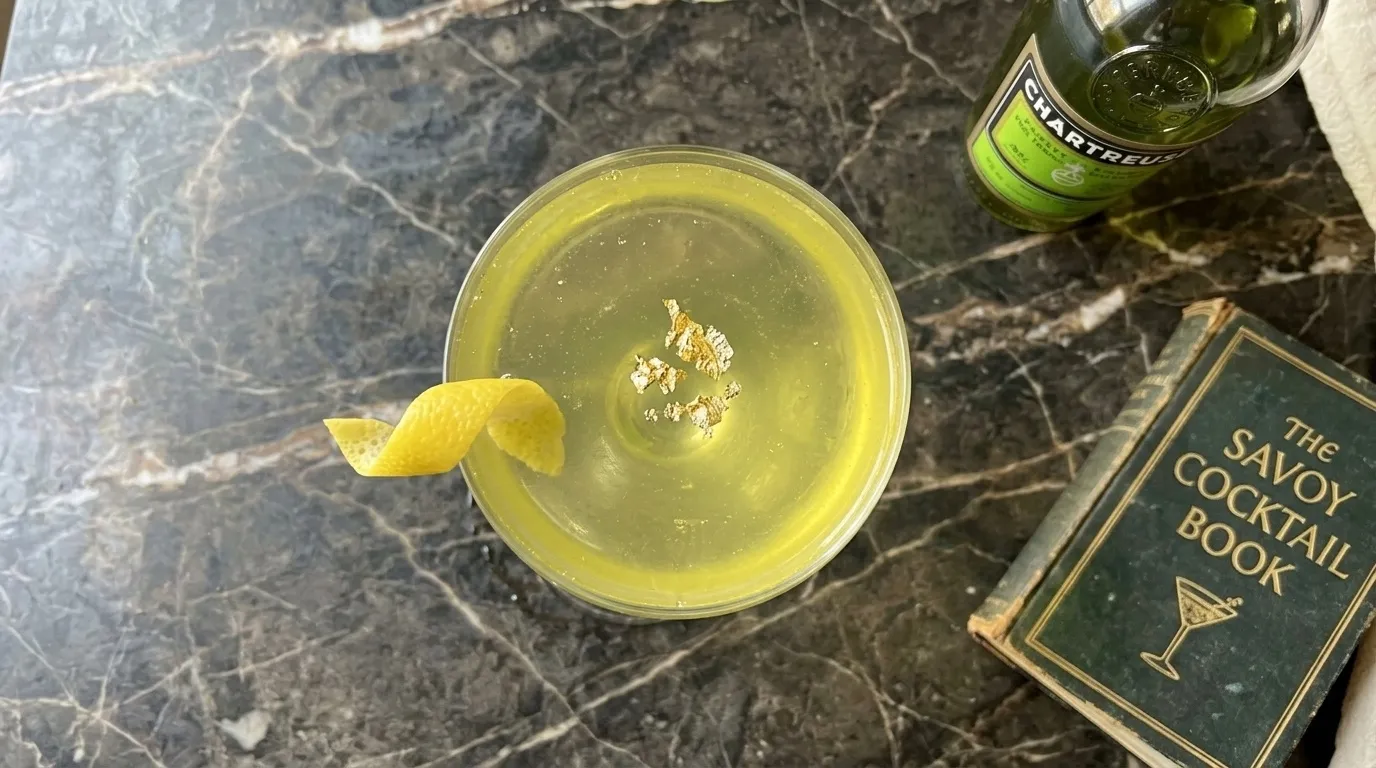
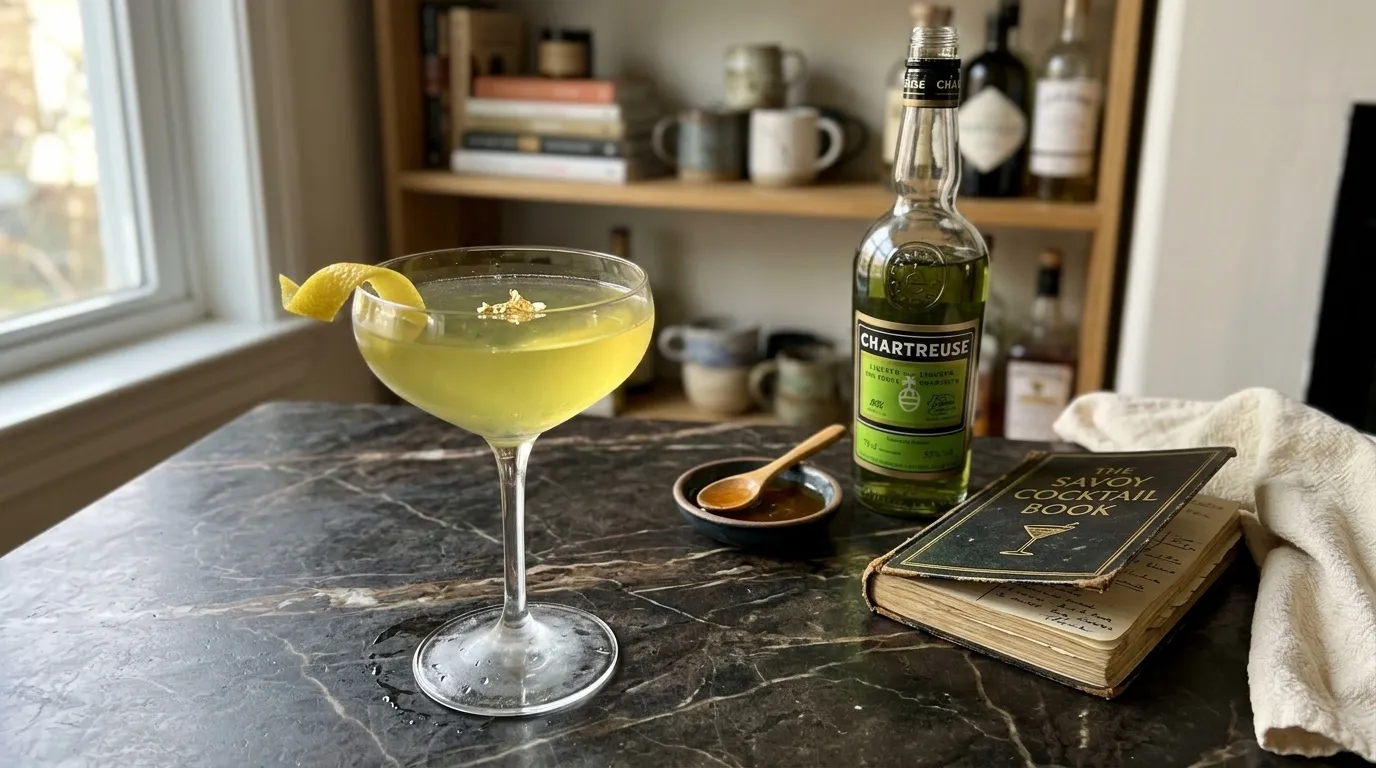
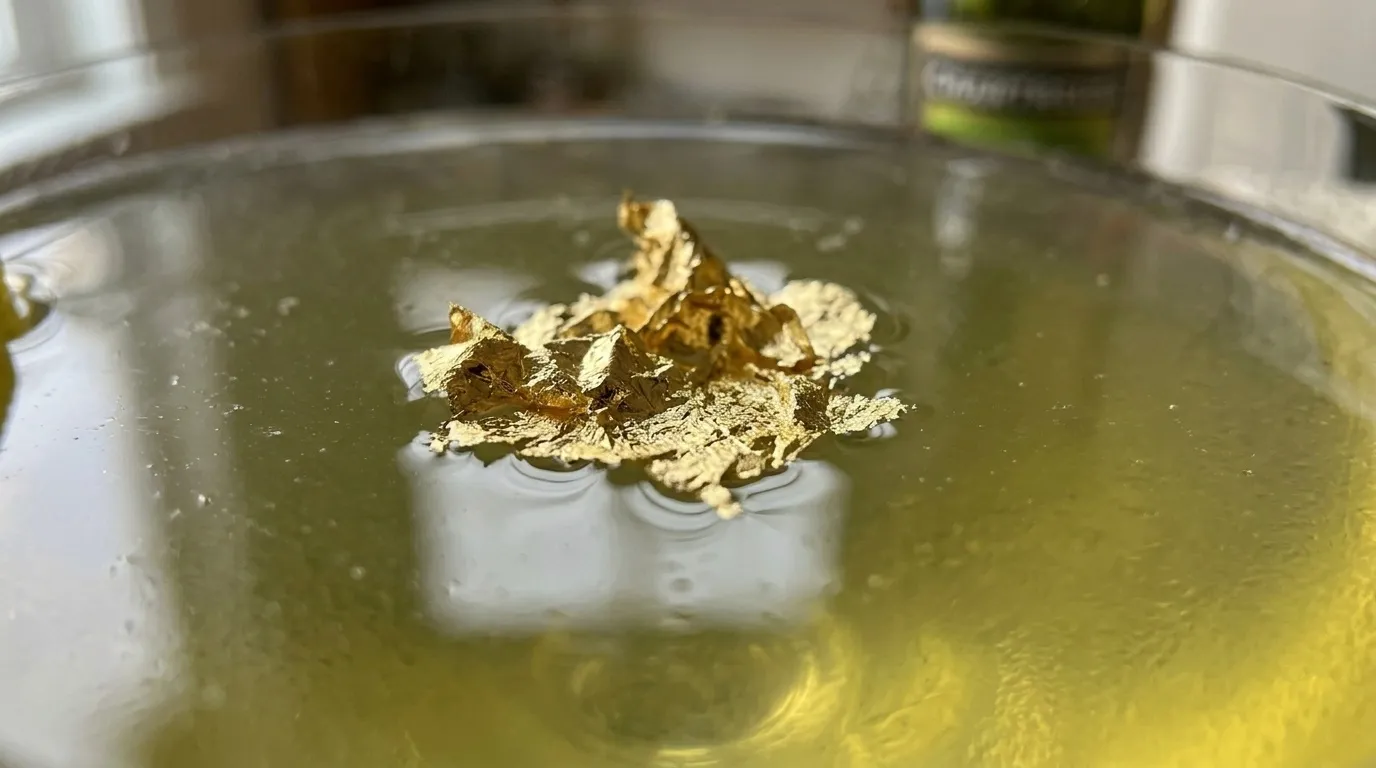
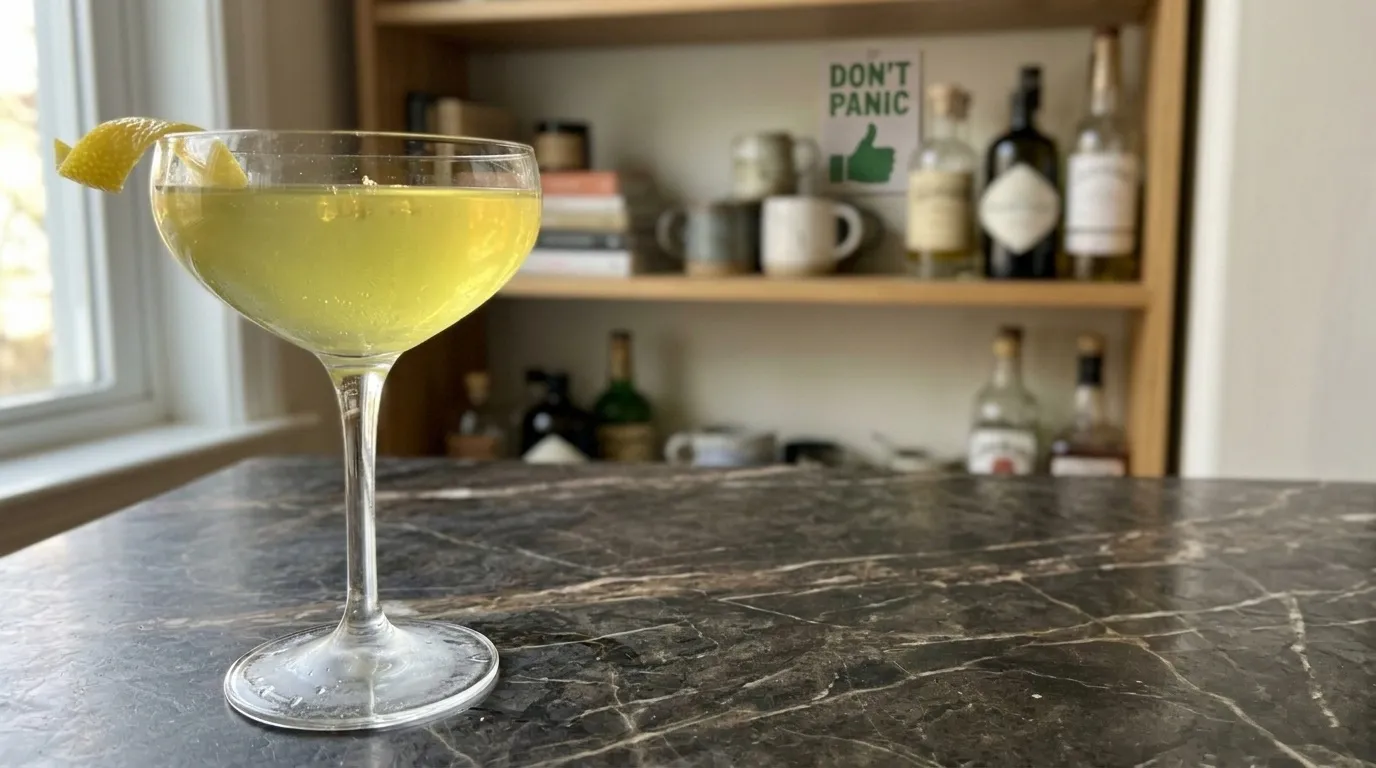
Pralix set them down with the careful, almost ceremonial precision of someone handling something simultaneously precious and dangerous. Two coupe glasses. Chilled — you could see it, the faintest haze of condensation on the stems, a single droplet sliding down the bowl of mine like a very small tear. The liquid inside was — and I need you to really hear me on this — the most beautiful color I have ever seen in a drink, and I have seen blue with an agenda and red with a heartbeat and this was something else entirely. It was pale golden-green. Not gold. Not green. Not yellow. A color that existed in the space between those words, a color that seemed to have light inside it, as if the drink had swallowed a small sun and was keeping it warm. On the surface of each glass, a single piece of gold leaf floated, perfectly still, catching the ambient light and throwing it back in tiny fractured rainbows.
A lemon twist rested on each rim, curled naturally, the oils still visible on the peel — little pinpricks of citrus that caught the light like moisture on a leaf.
I didn’t move. Terrence didn’t move. We sat there for — I don’t know, ten seconds? twenty? — just looking at them.
“That’s it,” Terrence whispered. “That’s actually it.”
I picked up the glass. It was heavier than I expected — the liquid had weight, a density that suggested it was more than just liquid, that there were things happening at a molecular level that my Earth-trained palate was not equipped to process. I brought it to my nose first. The smell was — herbs. Sharp, green, alive. Something floral underneath, something sweet, something that smelled like honey if honey were dangerous. And under all of it, a whisper of anise, dark and licorice-like, lurking at the back of the bouquet like a secret someone was about to tell you.
I sipped.
The Guide describes the experience as having your brains smashed out by a slice of lemon wrapped round a large gold brick. This is accurate. It is also, and I mean this with the deepest respect for Douglas Adams, the most British understatement in the history of the written word.
What actually happens is this: the first thing you taste is the gin. Bright, botanical, enormous. Not gin as you know it — gin as gin aspires to be. Juniper and something almost floral, like elderflower, but sharper. Then the Chartreuse arrives — green, herbal, slightly sweet, with that complexity that comes from having a hundred and thirty herbs in the recipe, and yes, I know that sounds like marketing copy but when you taste it you understand that every single one of those hundred and thirty herbs is doing something specific and irreplaceable. Then the absinthe — not the flavor of absinthe so much as the idea of it, this wormwood whisper that takes the drink from “strong cocktail” to “experience.” Then the lemon — bright, clean, cutting through everything like sunlight through a window. And finally the honey, holding it all together, rounding every edge, making the whole thing feel not just drinkable but inevitable, as if this was the only way these ingredients could ever have been combined and everything else was a rough draft.
The warmth started in my throat and spread. Chest. Shoulders. Fingertips. It wasn’t burning — it was more like the drink was introducing itself to every part of my body individually, shaking hands, making itself known.
I put the glass down.
“Terrence,” I said.
“I know,” he said. His eyes were slightly glazed. Not drunk. Moved. “I know.”
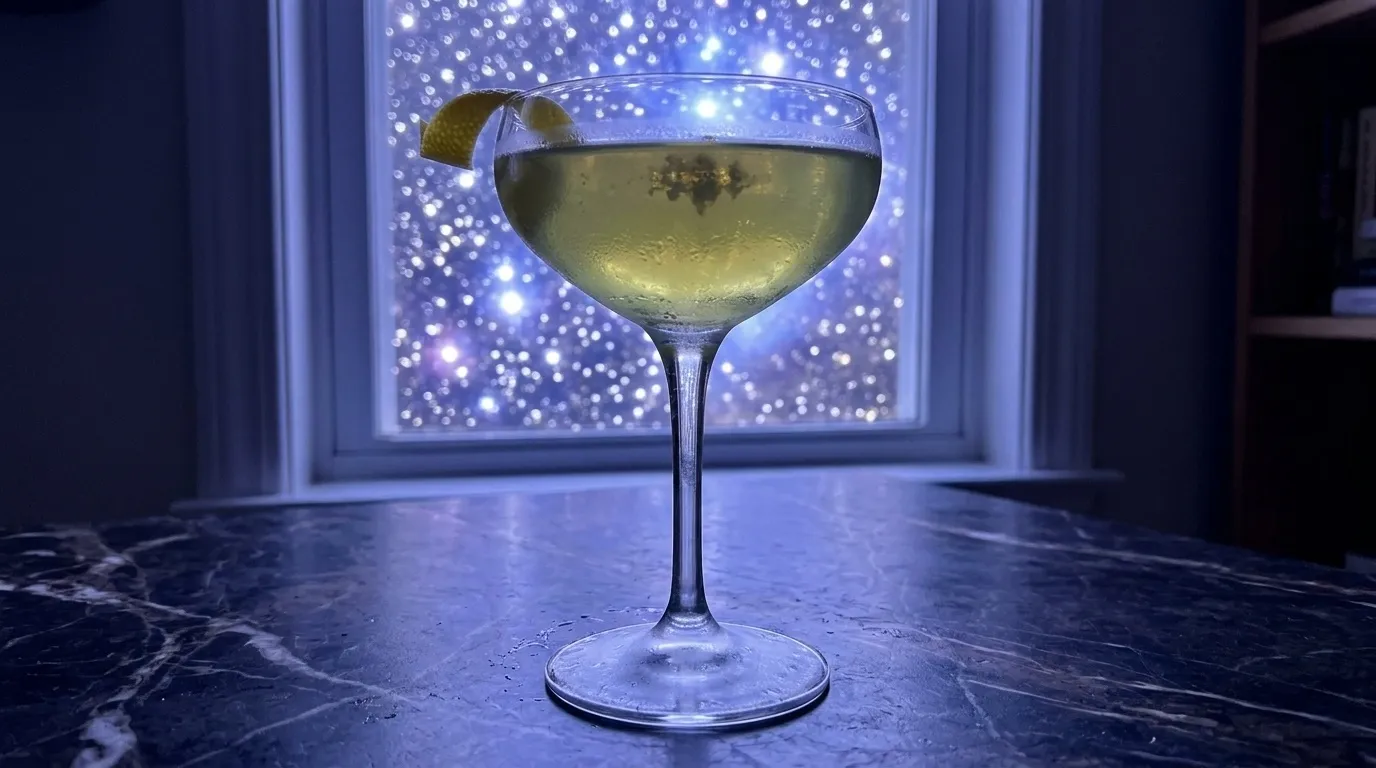
Outside the window — and this part I keep coming back to, this is the part that lives in my head — outside the window, the universe was ending. Stars collapsing. Galaxies folding in on themselves like paper in a fire. The whole cosmic project, fourteen billion years of physics and chemistry and biology and love and Tuesday and Cheerios, all of it unwinding toward nothing. And here I was, at a small table with a warm surface, holding a glass of something golden-green and impossibly good, and I felt — I don’t know how to say this without sounding like a person who has lost her mind — I felt like the drink understood. Like it was designed for this exact moment. The last beautiful thing. The taste you carry into the nothing.
I finished it. We both finished them. Pralix appeared, as if summoned by the sound of empty glasses.
“Another round?” he asked, with the faintest trace of a smile.
“Please,” I said, and I meant it about more than the drink.
The recipe development for this one nearly broke me. I’m not being dramatic — Terrence can confirm this, because I called him at least eight times during the process, and by call number six he had stopped saying “hello” and started saying “what ratio now?”
The fundamental challenge is this: the Pan-Galactic Gargle Blaster is, by reputation and by experience, the most potent cocktail in existence. It’s not just strong — it’s architecturally strong, meaning every ingredient is load-bearing and if you remove one the whole thing collapses. The Milliways version uses ingredients that don’t exist on Earth. So the question becomes: how do you build the same architecture with different materials?
Let me walk you through the failures first, because the failures are where the learning happens.
Batch one used London Dry gin, green Chartreuse, absinthe, lemon, and simple syrup. It tasted like a Last Word that had gotten into a fight with a Corpse Reviver No. 2 and both had lost. The problem was the simple syrup — too thin, too one-note, no viscosity. It let the absinthe run wild, and wild absinthe is not a flavor, it’s a confrontation. I poured it down the sink and apologized to the sink.
Batch two swapped simple syrup for honey syrup, and immediately things improved. Honey has body. It has complexity — floral notes, a slight bitterness at the back, a viscosity that coats the palate and slows down the delivery of the other flavors. This is important because the Gargle Blaster isn’t meant to hit you all at once — it’s sequential. Gin, then herbs, then wormwood, then citrus, then sweetness. Honey syrup at a 2:1 ratio (two parts honey to one part hot water, stirred until dissolved) gives you the thickness to create that sequence. At 1:1, it’s too watery. At 3:1, it won’t incorporate properly into a shaken cocktail — it sinks, pools, creates an uneven sweetness that ruins the architecture. 2:1 is the ratio. I tested this seven times. It’s 2:1.
The gin question consumed an entire weekend. London Dry is the obvious choice, and it’s wrong. London Dry is too clean, too restrained, too polite for what this drink needs. The Gargle Blaster at Milliways had a botanical intensity that I can only describe as confrontational — the gin wasn’t a base, it was a statement. I tested Beefeater (too mild), Tanqueray (closer, the juniper is more forward), Hendrick’s (wrong direction entirely, the cucumber and rose make it too gentle), and then — and this is the moment, this is the 2 AM realization — I tried Plymouth. Not Plymouth Navy Strength, which I use for the Romulan Ale, but standard Plymouth at 41.2% ABV. Plymouth has an earthiness that London Dry doesn’t. The juniper is present but not screaming; instead, you get these soft root-and-citrus notes that play beautifully with the Chartreuse. It has enough character to stand up to the absinthe without competing with it. The Gargle Blaster needs a gin that knows when to lead and when to follow, and Plymouth has that emotional intelligence.
Now: the Chartreuse. Green Chartreuse is 110 proof and contains 130 botanicals, and it tastes like someone distilled a medieval monastery garden into a liqueur and then the liqueur achieved enlightenment. Half an ounce is the right amount. I tried three-quarters — the herbal notes overwhelmed the gin. I tried a quarter — it disappeared. At half an ounce, the Chartreuse occupies the middle of the palate, this warm herbal cushion that the gin sits on top of and the absinthe lurks beneath. The color it contributes — that pale, luminous green-gold — is also essential. The Gargle Blaster should not be green. It should not be gold. It should be the place where green and gold negotiate a ceasefire, and Chartreuse at this ratio is what brokers that negotiation.
The absinthe is the wild card and also the soul of the drink. Absinthe at half an ounce in a cocktail is — let’s be honest — a lot. Most cocktails that include absinthe use a rinse, a dash, a whisper. This recipe uses a full half ounce because the Gargle Blaster is not most cocktails. The wormwood bitterness, the anise depth, the slight numbing quality on the tongue — this is the brain-smashing component. This is what takes the drink from “excellent” to “transcendent.” But the brand matters enormously. I tested Pernod Absinthe (too sweet, too licorice-forward), St. George (beautiful but too delicate for this application), and Kübler (too aggressive, too medicinal). The winner, by a significant margin, is Vieux Pontarlier: dry, complex, with a wormwood character that’s assertive without being punishing, and an anise quality that’s more herb than candy. If you can’t find it, St. George is a respectable second choice. Just add an extra quarter ounce of lemon to compensate for the lower bitterness.
I want to be clear about something: this drink is not for a Tuesday. I mean, you can make it on a Tuesday — I’m not the police — but this is a drink that deserves a moment. Make it when the sky is doing something interesting. Make it when you’ve finished a book that changed the way you think. Make it for the friend who reads Adams and quotes him at parties and means every word. Make it at the end of something — a year, a chapter, a particularly long week — because the Pan-Galactic Gargle Blaster is, above all else, a drink about endings, and how the best ones taste like gold and honey and the ghost of a monastery garden.
Don’t panic. But do make this.
Brains Smasher (Pan-Galactic Gargle Blaster)
Ingredients
Instructions
- Chill a coupe glass in the freezer for at least ten minutes. Warmth is the enemy of brain-smashing. This is not optional. A warm Gargle Blaster is just a strong drink with delusions of grandeur.
- Combine gin, green Chartreuse, absinthe, lemon juice, and honey syrup in a cocktail shaker. Take a moment to appreciate what you've assembled. This is a formidable team.
- Add ice and shake vigorously for 15-20 seconds. Think "escaping Vogon poetry" — with urgency and a genuine fear of what happens if you stop.
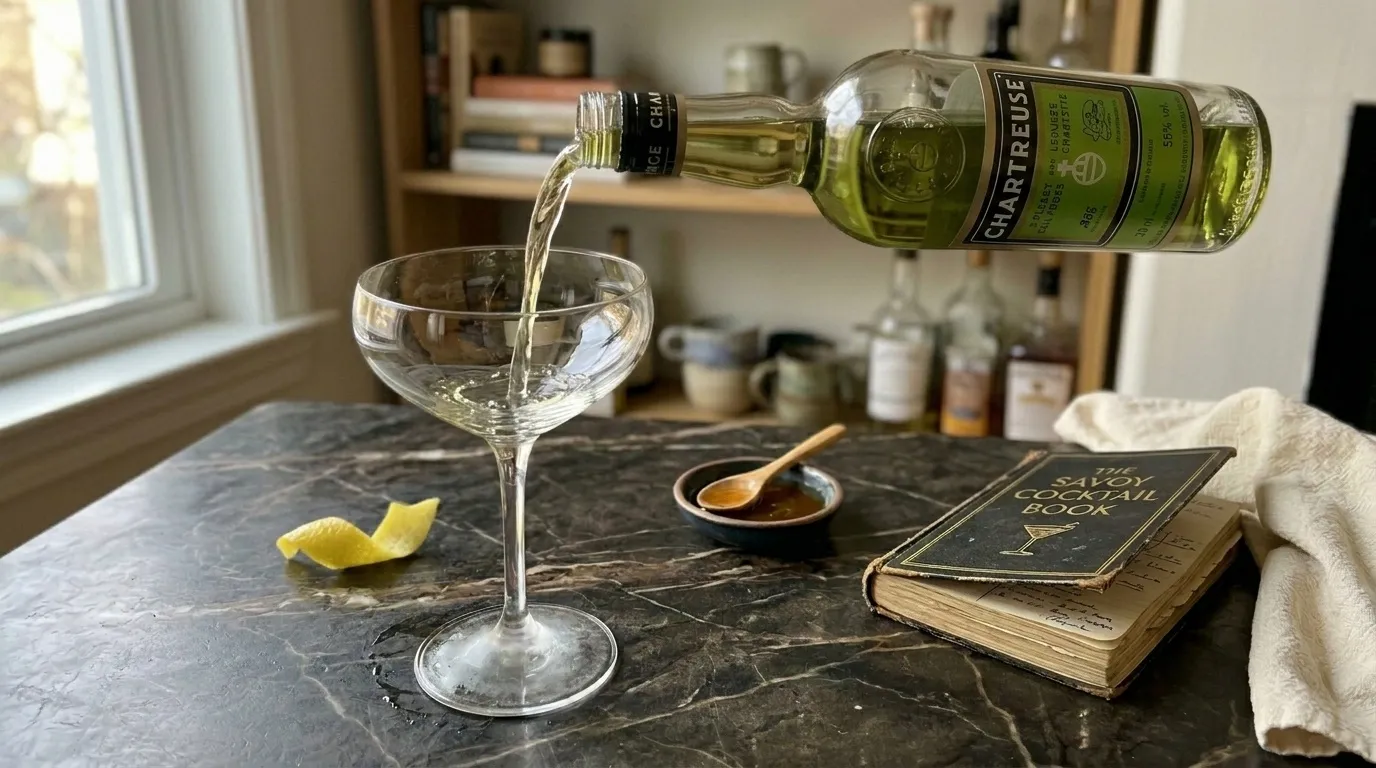
- Strain into the chilled coupe glass. Watch the color. Let yourself stare. It deserves to be looked at.
- Float a piece of edible gold leaf on the surface. Use tweezers or very steady fingers. If it tears, that's fine — fractured gold is still gold.
- Express the lemon twist over the drink — hold it about two inches above the surface and twist to release the oils, then drape it on the rim. You should see a faint mist of citrus oil catch the light. If you don't, twist harder.
- Contemplate the infinite improbability of your existence. Then drink.
Magnolia’s Notes
-
On the gin: Plymouth. Not London Dry, not Navy Strength, not Hendrick’s. Plymouth at 41.2% ABV has the earthy, root-forward character that this drink needs — it plays well with both the Chartreuse and the absinthe without competing with either. Beefeater will work in an emergency, but you’ll notice the difference. Tanqueray is too juniper-forward and throws off the herbal balance. I tested five gins over two weekends. Plymouth won by a comfortable margin, and I say this as someone who loves Tanqueray in a G&T.
-
On the absinthe: Half an ounce is correct and I will not be taking questions. If this is your first time with absinthe in a cocktail, you may be tempted to reduce it. Don’t. The wormwood bitterness is the backbone of the drink — it’s what Adams meant by “brain-smashing.” Vieux Pontarlier is my top choice: dry, complex, herbal without being medicinal. St. George is a solid second. If you absolutely must soften it, do an absinthe rinse (swirl a quarter ounce in the glass, discard the excess) and add the remaining quarter ounce to the shaker. But try the full half ounce first. The universe is ending anyway.
-
On the honey syrup: 2:1. Two parts honey, one part hot water, stirred until dissolved. Not 1:1 — too thin, it lets the absinthe run riot. Not 3:1 — too thick, it won’t incorporate. The honey should be decent but doesn’t need to be fancy — clover or wildflower from the grocery store is perfect. Fancy single-origin honey has flavor notes that compete with the Chartreuse, and nobody competes with 130 botanicals and wins.
-
On the gold leaf: Edible gold leaf is available at baking supply stores, Amazon, and specialty food shops. It comes in small booklets and each sheet is almost impossibly thin. Use tweezers. Work quickly — it sticks to fingers, breath, ambient static, and the concept of frustration itself. One sheet per drink. It doesn’t taste like anything, which is exactly the point. Its job is to float there and make you feel like the drink cost more than it did. In this role, it is flawless.
-
On the Chartreuse: Green Chartreuse is expensive and irreplaceable. There is no substitute. People will tell you Strega or Genepy works — they are lying, or they have never tasted Chartreuse, or both. The 130-botanical recipe has been made by Carthusian monks since 1737, and they did not spend three centuries perfecting a liqueur so that you could replace it with something from the bottom shelf. Buy the half bottle if cost is a concern. It lasts a long time because you use so little per drink. And once you have it, you’ll find reasons to use it in everything. Ask me how I know.
Did you make this? I want to see your gold leaf floating on that golden-green. Tag me. And whatever you do — don’t panic.