You guys. I need to talk about dying.
Not in a dark way. In a Dark Souls way, which is — okay, I realize that doesn’t sound less dark. But hear me out: there is a drink that exists at the intersection of failure and hope, and I have been trying to tell you about it for four months, and every time I start writing, I end up staring at my kitchen wall thinking about a bonfire that isn’t real and a flask that saved me more times than my health insurance, and I have to get up and walk around the house before I can come back and type actual words.
Some drinks are about celebration. This one is about getting back up.
The Story
This is Greg’s fault.
Greg is one of those friends who shows love by making you suffer. He’s the person who, upon finding a restaurant with a seventeen-alarm hot wing challenge, will not simply tell you about it — he will buy you a ticket, drive you there, and film your reaction for what he calls “the archive.” He once bought me a birthday present that was a box inside a box inside a box inside a box, and the last box contained a note that said “the real gift is perseverance,” and I didn’t speak to him for two days. He thought this was hilarious. He was not wrong, but I wasn’t going to tell him that.
Greg’s primary personality trait — and I say this with love, genuine love, the kind of love that survives being told “you should really play Dark Souls, it’ll be good for you” — is that he believes difficulty is a form of intimacy. He doesn’t recommend things because they’re fun. He recommends them because they’ll break you, and then he wants to sit with you while you put yourself back together. It’s a lot. He’s a lot. I have known him since college and I still don’t know if he’s a sadist or a therapist. Possibly both. Probably both.
The week he told me about Firelink Shrine, I was already having a rough time. Mark and I had been arguing about the bathroom renovation — not a big argument, not a relationship-defining argument, just the specific low-grade disagreement that happens when one person wants hexagonal tile and the other person thinks hexagonal tile is “a lot.” I was tired from a week of recipe testing for the blog — the Nuka-Cola Quantum post had gone through eleven batches and my kitchen smelled like a radioactive candy store. I was wearing my gray sweatpants, which are my “I have given up on today but not on tomorrow” sweatpants, and I was eating cereal at four in the afternoon.
Greg texted: “Have you ever been to Firelink Shrine?”
I should have put the phone down.
I typed: “No.”
“Do you want to go?”
“Greg, I am eating cereal in my sweatpants.”
“Perfect. You’re already in the right headspace.”
Firelink Shrine is not easy to get to, and I mean that in every sense. The journey itself is fine — unremarkable, even, a winding path through ruins and ash that would be almost meditative if your brain weren’t constantly scanning for things that want to kill you. Greg walked ahead of me with the confidence of someone who has been here many, many times. He was wearing hiking boots that had actual wear on them, not decorative-outdoorsy wear but the kind that comes from walking through places where the ground is not interested in your comfort. I was wearing sneakers. They were not the right shoes. They were never going to be the right shoes. I don’t know why I keep making this mistake.
The first thing you notice about Firelink Shrine is the sound. Or rather, the way sound works there — muted, dampened, as if the air itself is thicker than it should be. There’s music, but it’s so quiet you’re not sure it’s real. A slow, aching melody that seems to come from the stone rather than any instrument. It sounds like someone remembering a song they used to know. I stopped walking when I heard it. Greg noticed.
“Yeah,” he said. “It does that to everyone.”
The shrine is a ruin, but not in the way that word usually works. Ruins suggest something abandoned, something that fell apart. Firelink Shrine feels more like something that chose to be still. The stone is old — impossibly, unreasonably old — and worn smooth in places where people have been sitting, resting, catching their breath for longer than makes sense. There’s a central bonfire. Not a fire pit, not a campfire — a bonfire in the truest sense of the word: a fire that is the center of everything, the point around which the rest of the world organizes itself. The flames are the color of sunset and they don’t behave like normal fire. They burn steadily, without crackling, without spitting. They just are.
I sat down on the stone steps near the fire and the warmth hit me in waves. Not like a heater. Not like sitting near a fireplace at a restaurant that’s trying too hard. This warmth had texture to it — it found the cold places in your body, the tension in your shoulders, the chill you didn’t realize you’d been carrying, and it dissolved them. I sat there for a while. I think I sat there for a long time. Greg sat beside me and didn’t say anything, which is the most generous thing Greg has ever done.
The Firekeeper was there. She’s always there — that’s her job, her purpose, her entire existence. She tends the bonfire. She tends the people who come to it. She is small and quiet and draped in a dark robe and she has the kind of stillness that makes you want to be still too. Her eyes are covered — bound with a strip of dark cloth — and she moves through the space with a certainty that sight would only complicate. She knew we were there before we spoke. She always knows.
“Welcome to the bonfire, travelers,” she said, and her voice was — how do I describe this? It was the audio equivalent of the fire’s warmth. Low, steady, without urgency. The kind of voice that could tell you the world was ending and you’d think, okay, but she sounds like she has a plan. “Rest as long as you need.”
Greg gave me a look. The look that meant this is why we’re here.
“Can we —” I started, and didn’t finish, because I wasn’t sure what I was asking. Can we stay? Can we rest? Can we sit by this fire until I stop feeling like the bathroom tile argument matters?
“You can,” she said, answering the question I hadn’t asked. I didn’t find this strange. Nothing at Firelink Shrine is strange. Everything is exactly as it should be.
There was another traveler resting by the bonfire — a knight in the most extraordinary armor I have ever seen. It was shaped like an onion. I don’t mean that metaphorically. The helmet, the chest piece, the whole ensemble — round, layered, unmistakably onion-shaped. He was sitting with his back against a crumbled wall, legs stretched out, arms crossed, making a sound that was either laughing or sighing. Greg grinned when he saw him.
“Siegmeyer,” Greg said, like greeting an old friend.
“Hmm? Oh! Visitors!” Siegmeyer’s voice boomed out from inside the onion helmet, warm and jovial and completely at odds with the somber atmosphere. “Magnificent! Come, come. Sit. Rest. Have you tried the Estus? You must try the Estus. It is — and I say this with total conviction — the finest thing in this or any realm.”
He lifted a small flask. It glowed. Not reflected-light glow, not ambient-glow — the flask was producing its own light from inside, a deep, warm, amber-orange radiance that pulsed gently, like a heartbeat. Like a held breath. Like a promise.
The Firekeeper brought us each a flask. She moved without sound — bare feet on ancient stone, her hands steady, the flask transferring from her palms to mine with a care that made me hold it the same way. The glass was warm. Not hot — warm the way a mug of tea is warm after exactly the right amount of time, the temperature that says drink me now, this is the moment.
I need to tell you about the color. Because the color is important and I’m going to take my time with it.
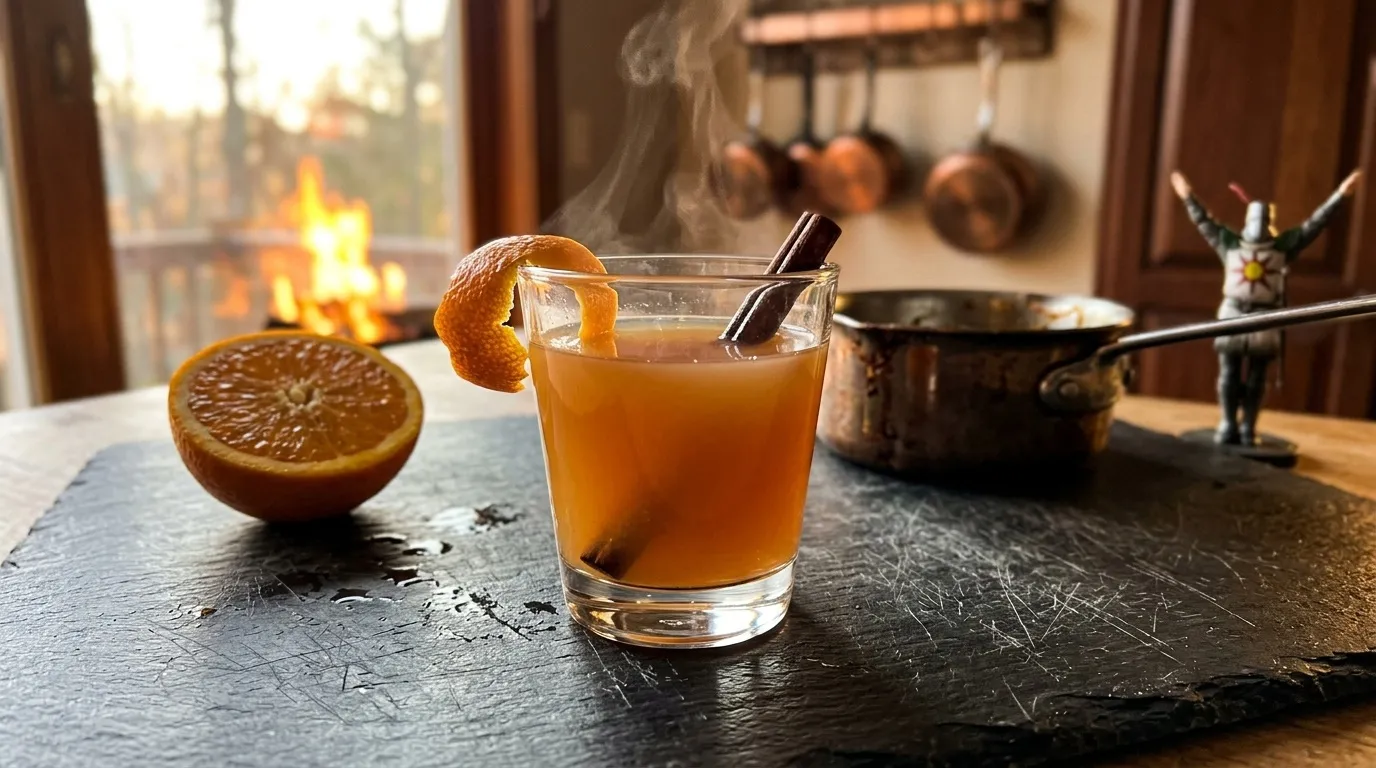
Estus is amber. But calling it amber is like calling the ocean blue — technically accurate, wildly insufficient. It was amber the way fire is amber at its deepest part, right at the base where the flame meets the wood and the color concentrates into something almost solid. There was orange in it — a warm, living orange, not traffic-cone orange, not juice orange, but the orange of the sky twenty minutes after sunset when the light is hanging on by its fingertips. And underneath that, a thread of gold, thin and bright, like the drink was keeping a secret at the bottom.
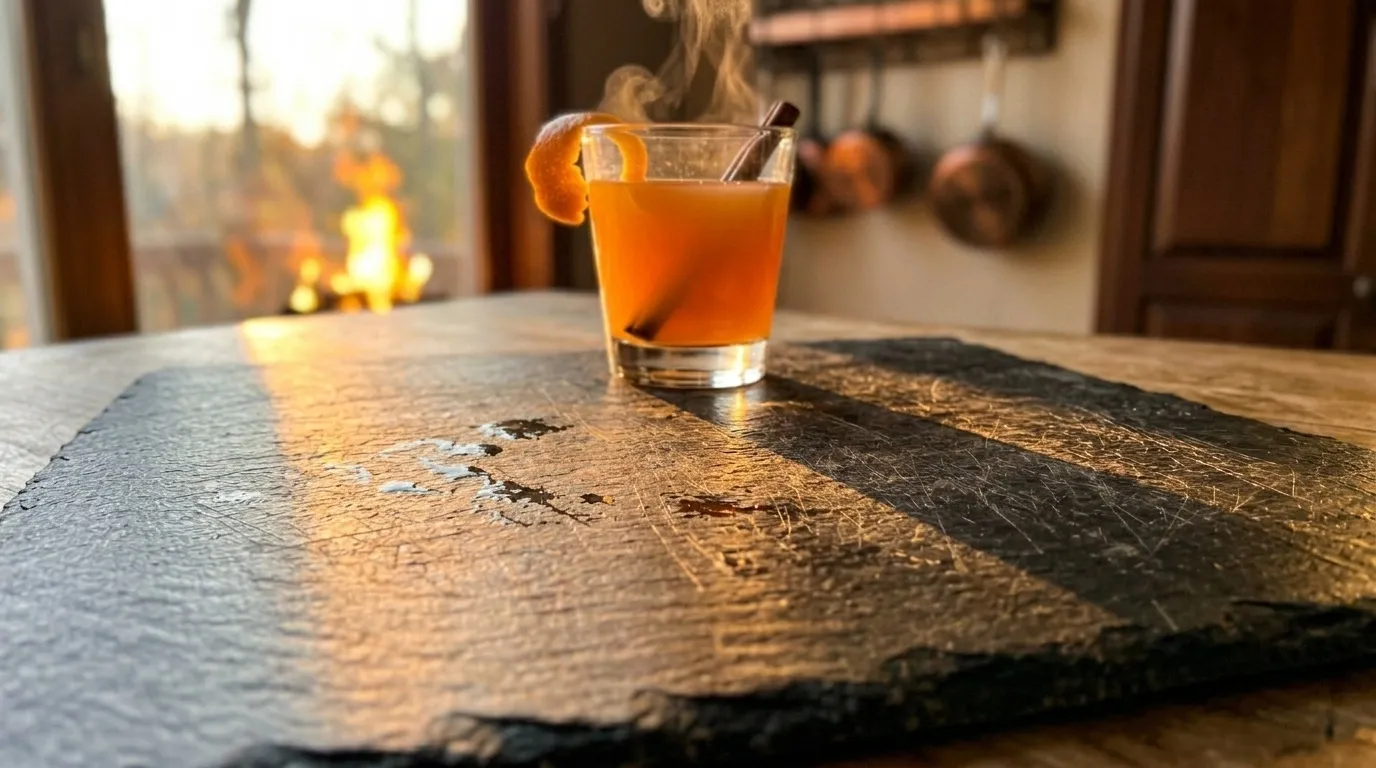
It moved when I tilted the flask. Slowly. Thick enough to cling, thin enough to flow. It coated the glass and left trails — legs, a sommelier would say, but that word is too clinical for what I was looking at. These were traces. Evidence. Proof that something warm and alive had passed through.
The smell reached me before I drank. Cinnamon, first and clearest. Then ginger — not powder-ginger, fresh ginger, sharp and bright and a little mean. Orange peel. Honey. And underneath everything, the deep, sweet darkness of bourbon. It smelled like November. It smelled like the inside of a glove.
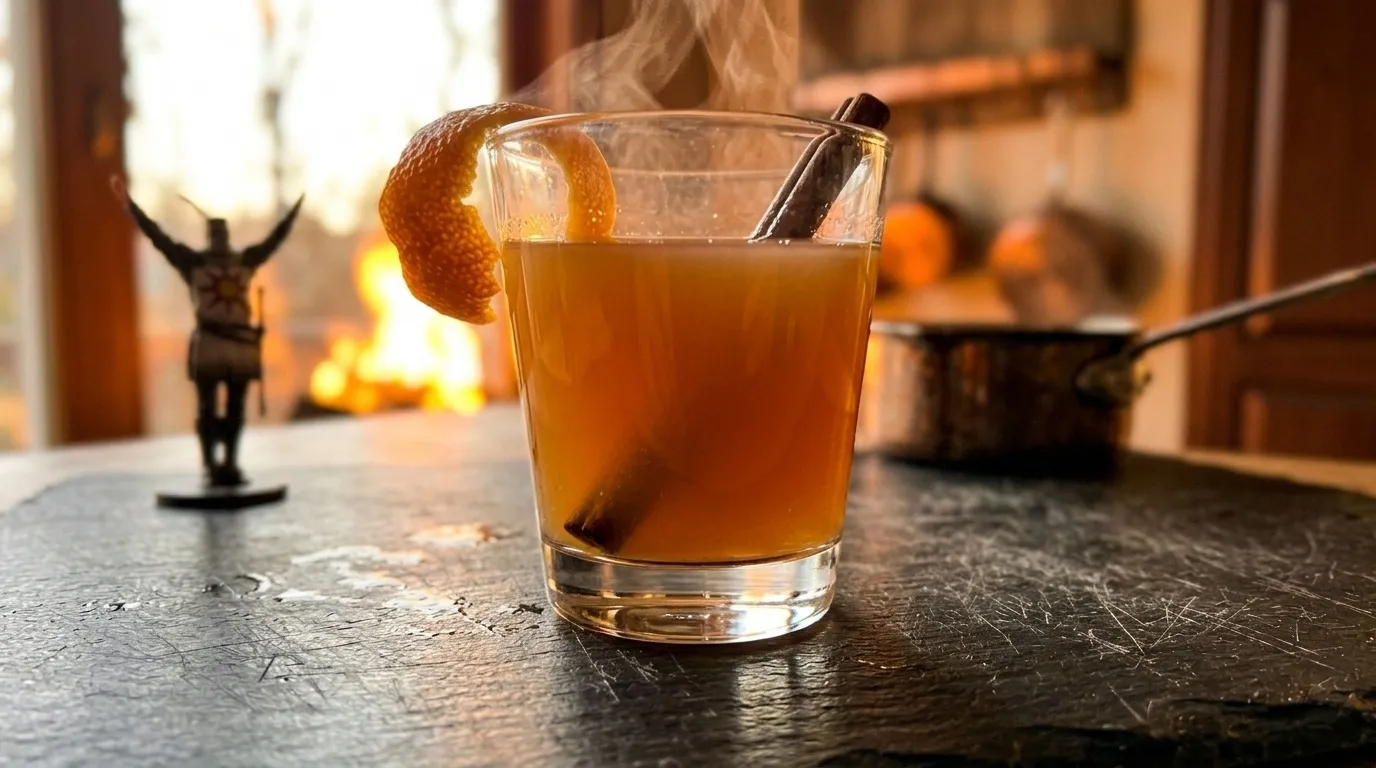
I drank.
The first thing was the heat. Not spice-heat, not burn — a warmth that entered my throat and expanded, slow and deliberate, into my chest. Then the ginger arrived, sharper, higher up, tingling at the back of my palate and spreading across my tongue. The bourbon grounded it — oak and vanilla and smoke, the kind of warmth that has weight to it. The honey smoothed the transitions. The cinnamon lingered. The orange was there and gone, a brightness at the edges, a flicker.
I set the flask down and I felt — this is going to sound dramatic, but I’m a food blogger, so dramatic is my factory setting — I felt repaired. Not fixed. Not healed. Repaired, in the mechanical sense, in the way that something that was functioning at sixty percent is now functioning at ninety. My shoulders dropped. My jaw unclenched. The bathroom tile argument felt very far away.
“You see?” Siegmeyer said, from inside his onion. “The finest thing.”
I looked at Greg. He was watching me the way he always watches people when they experience something he loves for the first time — quiet, focused, a little proud.
“I told you,” he said. “It’s good for you.”
He was right. I hate that he was right. But he was right.
I started working on the recipe two days after we got home, while the sense-memory was still fresh. I wanted to capture it before my brain filed it away and smoothed out the details — before the specific warmth became “warm” and the specific color became “orange.” I set up in the kitchen and told Mark it would be a few days. It was three weeks. The hexagonal tile discussion was tabled indefinitely.
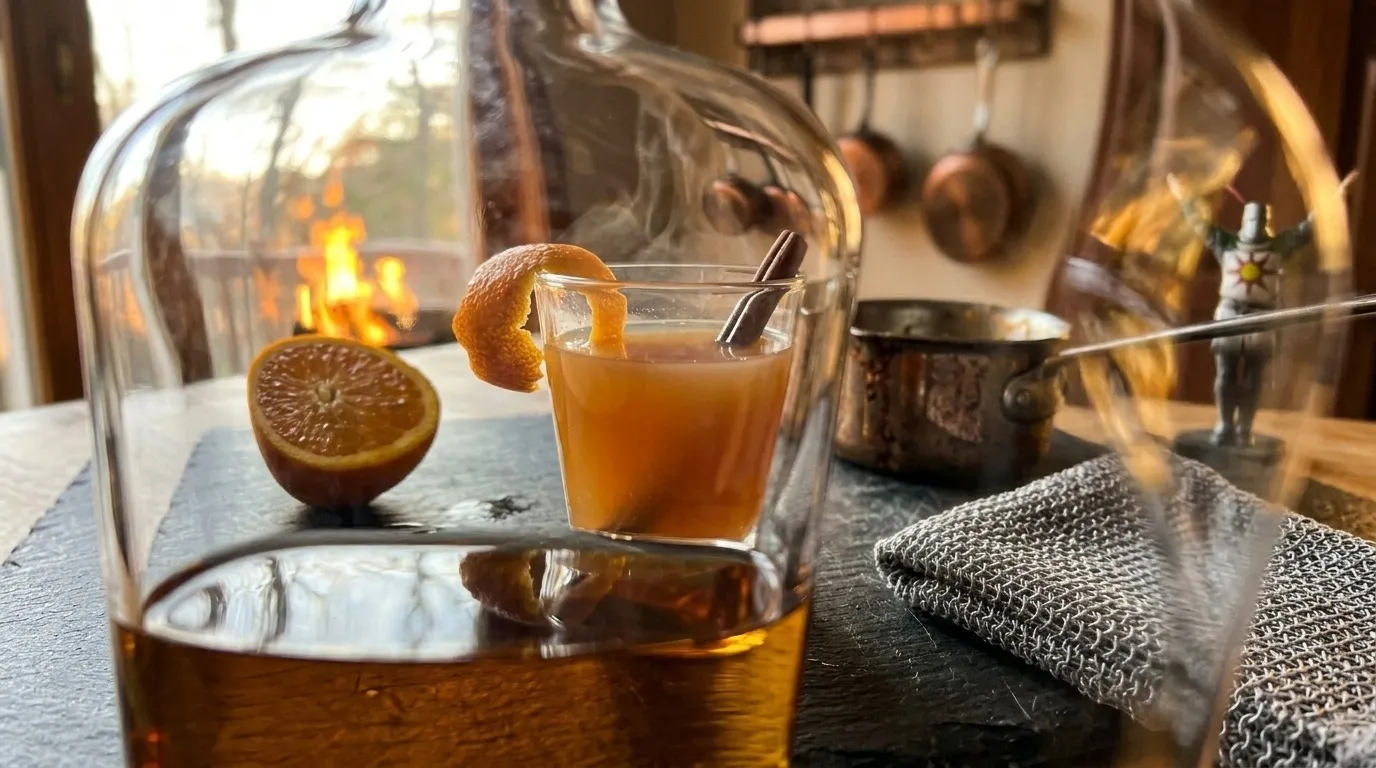
The bourbon was the easy part. Estus is, at its core, a warm bourbon drink, and bourbon has the profile I needed — sweetness, oak, a little smoke, a richness that deepens when you heat it. But which bourbon matters more than people think. At lower proofs — your standard 80-proof bottles — you lose the bourbon’s voice when you warm it. The heat evaporates the lighter aromatics and you’re left with something that tastes like sweet hot water with a memory of whiskey. You want 100 proof minimum. Wild Turkey 101 is my workhorse here — at 101 proof, it’s hot enough to maintain structure when warmed, and the high rye content in the mash bill gives it a spiciness that plays beautifully with the ginger and cinnamon. Maker’s Mark 46 is the luxury option if you want more vanilla and caramel in the body. Evan Williams Bottled-in-Bond at 100 proof is the sleeper pick — genuinely excellent bourbon for half the price, and it takes heat like a champion.
The ginger was the problem child. Fresh ginger juice is the soul of this drink — that sharp, almost aggressive warmth that cuts through the sweetness and gives the Estus its bite. But fresh ginger juice varies wildly. A young, smooth-skinned knob of ginger gives you a milder, more citrusy juice. The older, gnarlier stuff — the ginger that looks like it’s been through something — gives you heat. Real heat. The kind that makes the back of your throat tingle and your eyes widen slightly. That’s what you want. I tested this with a juicer, a microplane-and-cheesecloth method, and a garlic press, and the garlic press actually won — it extracts the juice without incorporating too much of the fibrous pulp, giving you a cleaner, more concentrated burn. Half an ounce is the sweet spot. A quarter ounce is pleasant but polite. Three-quarters is a warning. You know yourself.
The honey syrup ratio took four batches to dial in. Most recipes call for simple syrup — equal parts sugar and water — but honey behaves differently. At a 1:1 ratio, honey syrup is too thin and gets lost in the warm bourbon. At 3:1, it’s practically undiluted honey, too viscous to incorporate and too sweet. The 2:1 ratio — two parts honey to one part hot water, stirred until dissolved — gives you a syrup that’s thick enough to coat and sweet enough to balance the ginger without overwhelming the bourbon. Use a robust, dark honey here, not the plastic-bear stuff. Buckwheat honey is extraordinary in this context — it’s malty and molasses-forward and tastes like someone distilled autumn into a jar. Wildflower honey is the safe choice and still excellent. Clover honey works but reads a little one-dimensional against the spice.
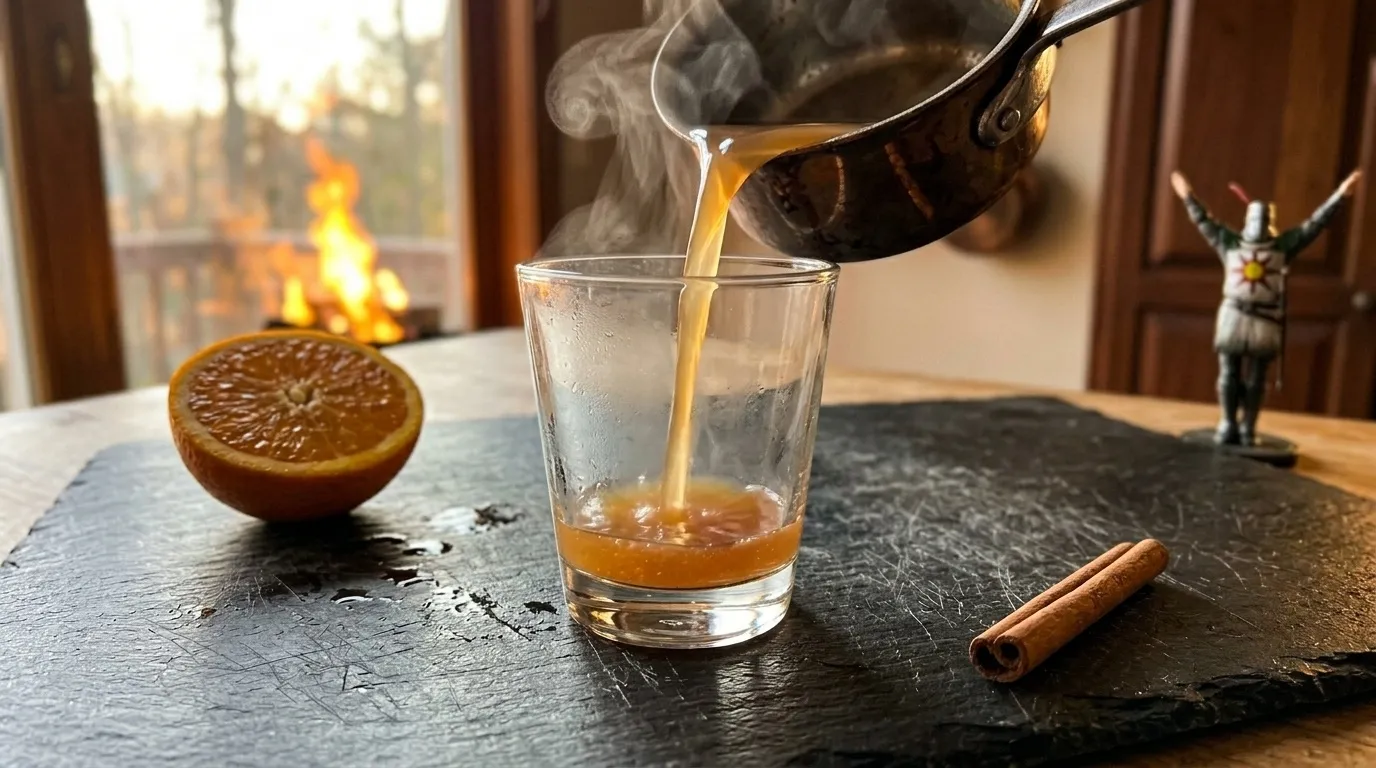
The warming technique is where most people will go wrong, and I need you to pay attention here. You are not boiling this drink. You are not simmering this drink. You are warming it, which means low heat, gentle heat, the kind of heat that takes patience. Pour the bourbon, orange juice, honey syrup, and ginger juice into a small saucepan and set it over the lowest flame your stove will give you. You want the liquid to reach about 150 degrees Fahrenheit — warm enough to release the aromatics, warm enough to feel like a bonfire in a glass, but well below the 173-degree point where alcohol starts to evaporate in earnest. If you see bubbles, you’ve gone too far. If steam is rising aggressively, you’ve gone too far. You want the barest whisper of steam. A suggestion. A rumor of heat. This is the difference between a drink that warms you from inside and a drink that tastes like hot juice.
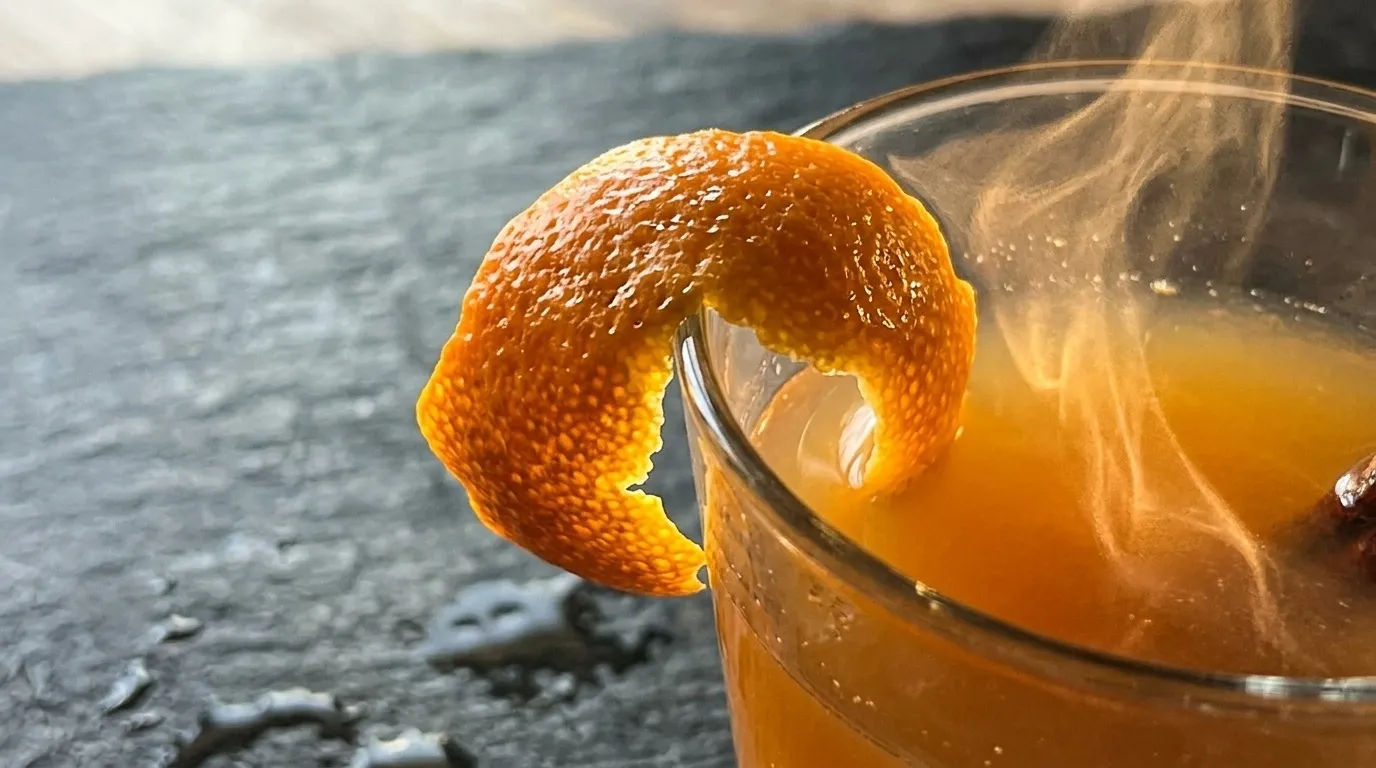
The cinnamon stick steeps in the warm liquid for two to three minutes, and I mean that precisely — I set a timer. Under two minutes and the cinnamon is decorative. Over four minutes and it starts to dominate, pushing the drink toward “holiday spice” territory when what you want is “ancient fire.” The bitters go in after you pull the saucepan off the heat, because Angostura’s aromatics are volatile and they’ll vanish if you cook them. Two dashes. Not three. Three makes it medicinal. The orange peel gets expressed over the surface at the very end — hold it over the glass, give it a firm twist, and watch the oils mist across the surface. That fine spray of citrus oil is the first thing your nose encounters, and it bridges the gap between “cocktail” and “potion.”
Make this for the nights that beat you. Make this for the third attempt, the seventh draft, the argument about tile that isn’t really about tile. Make this when someone you trust drags you somewhere hard and you come back different. Make this and sit with it and let the warmth do what warmth does.
Rest at the bonfire. You’ve earned it.
Liquid Courage (Estus Flask)
Ingredients
Instructions
- Combine the bourbon, orange juice, honey syrup, and ginger juice in a small saucepan over the lowest heat your stove will give you. We're kindling a bonfire, not invading the Demon Ruins.
- Warm gently until you see the barest whisper of steam. If it bubbles, you've gone hollow — pull it back.
- Add the cinnamon stick and let it steep for exactly 2-3 minutes. Set a timer. The bonfire is patient and so are you.
- Remove from heat and add the bitters. They go in now, not before — the heat would exile their aromatics to the abyss.
- Pour into a heat-safe glass or, ideally, a small flask-shaped vessel you bought specifically for this purpose and refuse to explain to guests.
- Express the orange peel over the drink — hold, twist, watch the oils catch the light — then rest it on the rim.
- Drink while praising the sun. [T]/
Magnolia’s Notes
- On the bourbon: Proof matters more here than in any other cocktail I make. At 80 proof, the bourbon fades to a whisper when warmed — you get sweetness and not much else. At 100 proof, it holds its shape. Wild Turkey 101 is my go-to: high rye, high proof, and it actually improves with gentle heat. Maker’s Mark 46 is the special-occasion choice. Evan Williams Bottled-in-Bond is the budget pick that punches so far above its weight class it’s frankly embarrassing for more expensive bottles. Don’t use anything with “honey” already in the name — you’re adding your own honey and you don’t need the redundancy.
- On the ginger: Fresh ginger juice or nothing. The stuff in a bottle tastes like ginger’s LinkedIn profile — technically accurate, completely soulless. Use a garlic press on a gnarly, old piece of ginger and squeeze it through a fine mesh strainer. You want the juice to be sharp enough to make you inhale slightly when you smell it. That’s the burn. That’s the whole point. Half an ounce is the Goldilocks zone — enough to feel the warmth spreading through your chest, not so much that you’re coughing into your Estus Flask.
- On the honey syrup: Two parts honey, one part hot water, stirred until dissolved. Use a dark, robust honey — buckwheat is extraordinary here, with malty depth that tastes like it was harvested somewhere ancient. Wildflower is the safe bet. Store-brand clover from a plastic bear will technically work, but you’ll know. You’ll know and I’ll know and we’ll both pretend it’s fine and it won’t be fine. Keeps in the fridge for a month.
- On the warming technique: 150 degrees Fahrenheit. That’s your target. A faint wisp of steam, not a rolling boil, not even a simmer. If you have an instant-read thermometer, use it. If you don’t, watch for the moment when the liquid starts to move — the faintest convection currents, a shimmer in the surface. That’s your moment. Pull the cinnamon after three minutes maximum. Add the bitters off heat. This is a drink that rewards patience and punishes impatience in exactly the way its source material would want.
- On the ritual: Serve this warm, drink it slow. This isn’t a shot. It’s a rest at the bonfire. Hold the glass with both hands. Let the warmth come through the walls. If you’re playing Souls while drinking this, take one sip per death, but pace yourself — that boss fight isn’t going anywhere and neither is your drink.
Did you make this? Show me. But don’t tell me how many attempts it took — I already know. Praise the sun, friends.