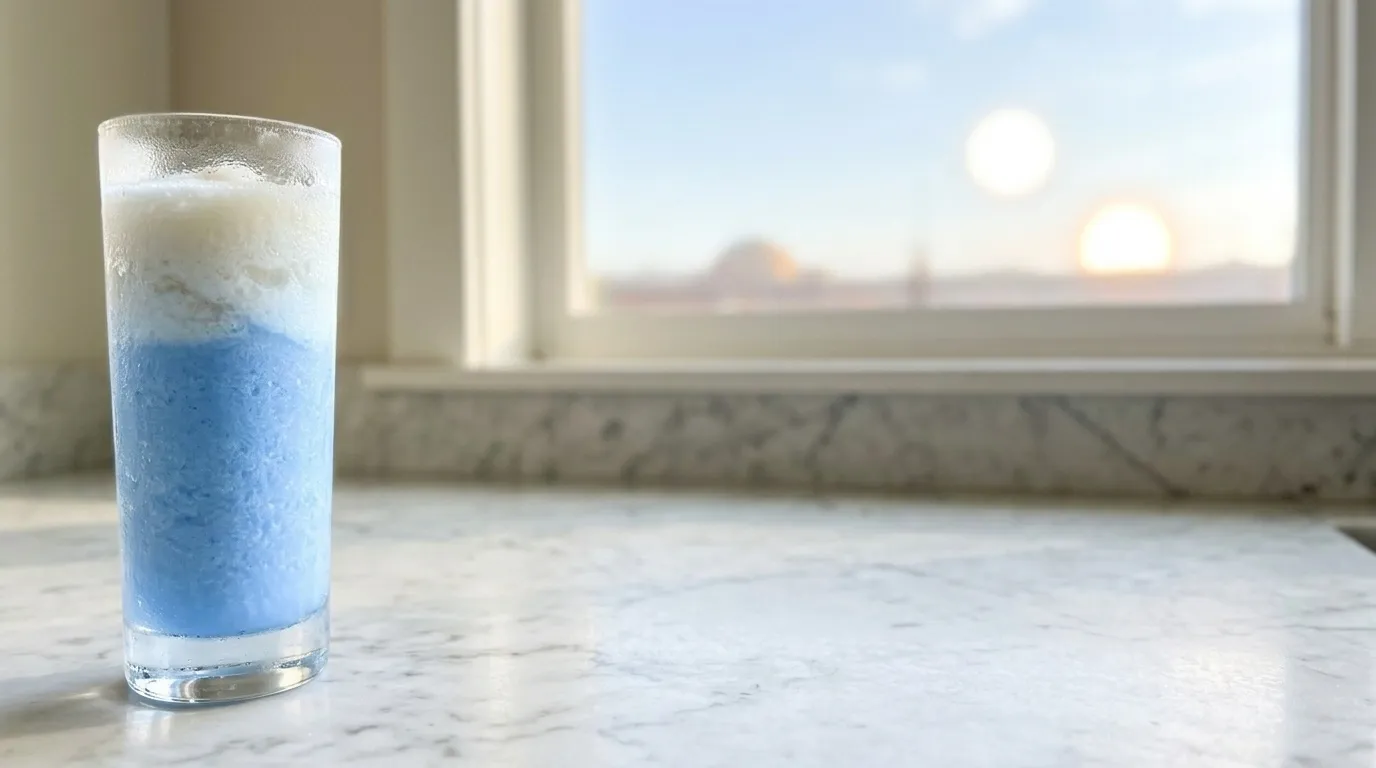
You guys. YOU GUYS.
I have been staring at this drink on my kitchen counter for twenty minutes. Not drinking it. Not photographing it. Just staring, because the blue is doing something I can’t explain and I need to process it before I can hold a glass with steady hands.
But I’m getting ahead of myself. Let me go back to the beginning. The very beginning — the couch in my parents’ living room, the orange carpet (it was the nineties, don’t judge us), and the exact moment a nineteen-year-old moisture farmer picked up a glass of something blue and changed the entire trajectory of my life.
I was eight years old, rewatching A New Hope for what my dad estimated was the twenty-third time but what I maintain was only the nineteenth or twentieth, and there it was: Luke Skywalker, angsty farm boy extraordinaire, sitting at his aunt and uncle’s dinner table on a desert planet with two suns, casually drinking the most aesthetically aggressive beverage I had ever seen in my life.
Not green. Not purple. Not teal. Blue. A blue so confident, so completely unbothered by its own intensity, that it seemed to be daring the viewer to question it. It was the blue of a swimming pool in a toothpaste commercial. The blue of something that absolutely should not be consumed but clearly, emphatically was.
“That’s from a bantha,” my dad said from the other end of the couch. He was not looking at the screen. He was looking at his phone, which in 1998 meant he was playing Snake, which tells you everything you need to know about my father’s relationship to the Star Wars franchise. He liked it fine. He just also liked Snake. “A big hairy alien cow thing,” he added, and returned to his game.
I sat there on the orange carpet — we didn’t sit on the couch because the couch was for adults and we were not yet adults, this was made clear — and I felt something shift inside my eight-year-old brain. Not a desire to join the Rebellion. Not an aspiration to become a Jedi. Something more specific, more urgent, more fundamentally me: I needed to know what that blue milk tasted like. I needed to understand the beverage that sustains a moisture farmer through those long, dual-sunset evenings when the sand is cooling and the sky looks like someone spilled two different paints and both of them are beautiful.
That obsession lived in me for twenty years like a low-grade fever. I thought about Blue Milk at inappropriate times. During exams. At my cousin’s wedding. Once during a job interview — the interviewer asked me where I saw myself in five years and I almost said “Tatooine.” I did not get the job. I don’t think those two facts are related but I can’t be certain.
Then my friend Priya texted me.
Priya is a structural engineer. This is relevant because structural engineers, in my experience, have a very specific kind of confidence — the confidence of someone who understands load-bearing walls, who knows which things are holding up which other things, and who therefore approaches the world with a casual certainty that the rest of us, who do not understand load-bearing walls, find both reassuring and slightly unnerving. Priya once rearranged the furniture in my living room without asking and it was better. She just looked at the room, saw the correct arrangement, and started moving the couch. Mark helped. He did not question it either.
“I’m going to Mos Eisley next month,” her text said. No preamble. No context. Just the sentence, followed by a second text that said: “Do you want to come.”
Not a question mark. A period. Priya doesn’t ask questions. She makes statements that technically allow for refusal but structurally discourage it.
I was at the grocery store when I got this text. I was standing in the dairy aisle, which is ironic or possibly prophetic, holding a carton of oat milk that I was buying because Mark had read an article about gut health. I stood there between the oat milk and the almond milk and the cashew milk and the seventeen other non-dairy milks that line the refrigerator case like a United Nations of things pretending to be milk, and I thought: none of these are blue. None of these have ever been blue. None of these will ever be blue. And I texted back: “Yes.”
I bought the oat milk too. Mark’s gut health matters. But my priorities had shifted.
Here is what I need you to understand about Tatooine: it is hot. I know that seems obvious. It’s a desert planet. It has two suns. You’ve seen the movie. But knowing a thing intellectually and experiencing it with your entire body are different events, and I was not prepared.
Priya and I landed at Mos Eisley spaceport in what I can only describe as an afternoon that had strong opinions about temperature. The heat wasn’t ambient — it was directional. It came from above (two suns), from below (sand that had been absorbing two suns’ worth of energy since dawn), and from the side (other people’s body heat, because the spaceport was packed). I was wearing linen pants and a white shirt because I’d read that light colors reflect heat, which is true in a laboratory and completely meaningless in Mos Eisley.
“You’re already sweating,” Priya observed. She was wearing a tank top and cargo shorts and looked like she’d just stepped out of air conditioning. Structural engineers also apparently have superior thermoregulation.
The spaceport itself was chaotic in the way that only truly functional places are chaotic — it worked, everything was moving in the right direction, but it looked like it shouldn’t. Landspeeders parked at angles that defied geometry. Jawas pushing carts of scavenged droid parts through gaps that shouldn’t have accommodated a cart. A Twi’lek woman arguing with a docking agent about a fee that she clearly felt was unreasonable, gesturing with both hands and both lekku, which made her argument four-limbed and therefore twice as persuasive.
I was carrying a bag that was too heavy because I’d packed two changes of clothes, sunscreen (SPF 70, which Priya said was “paranoid” and which I said was “appropriate for a planet with two suns, Priya”), a portable blender battery pack, my notebook, and four protein bars because I didn’t know what the food situation would be and I have been burned before. Priya was carrying a single canvas tote. She’d packed for Tatooine the way she rearranges living rooms: with an economy that implied she understood something fundamental that I did not.
The walk to Chalmun’s Cantina took twenty minutes. It should have taken ten, but I stopped three times — once to look at a moisture vaporator up close (they’re taller than you think, and they hum, a low resonant hum that vibrates in your sternum), once because my shoe filled with sand in a way that required immediate intervention, and once because I saw a dewback and needed a moment. Dewbacks are enormous. The pictures don’t prepare you. This one was lying in the shade of a loading dock, its massive flanks moving with slow, contented breaths, and it looked at me with an eye the size of a grapefruit and a level of disinterest that I found deeply humbling.
“It’s a lizard,” Priya said.
“It’s a dinosaur,” I said.
“It’s a big lizard and we’re late.”
We were not late. There was no appointment. But Priya walks with appointment energy regardless of whether an appointment exists, so I emptied the sand from my shoe and followed.
Chalmun’s Cantina is below street level. You go down a set of steps that are worn smooth in the center from a million footsteps, and the temperature drops by about fifteen degrees, which felt so good that I made a noise. I’m not proud of the noise. It was involuntary. Priya pretended not to hear it.
The interior was dim — not dark, but dim, the way a cave is dim, the way shade is dim on a planet where the alternative is two suns trying to cook you. The walls were curved, adobe or something like it, the color of wet sand gone dry. There were alcoves along the sides where groups sat in semicircular booths, and the main bar ran along the back wall, long and scarred and made of something I couldn’t identify — a stone, maybe, or a composite, slightly cool to the touch when I rested my forearm on it, which I did immediately because I was still hot and any cool surface was a gift.
The Bith band was playing. I have to talk about the Bith band. They were in a raised alcove to the right, four of them, and they were playing a song that I recognized from the movie but that sounded completely different in person — fuller, more textured, with a bass line that you felt in the floor rather than heard. One of them was playing something that looked like a clarinet if a clarinet had been designed by someone who had never seen a clarinet but had one described to them over a bad comm connection. The music wasn’t background. It was architecture. It held the room together.
I was staring at the band when the bartender appeared.
Wuher. That’s his name, and his name is all you need because he is exactly one thing and he is that thing completely: a bartender who has seen everything, is impressed by nothing, and would like you to order so he can go back to not talking. He was wiping a glass when we sat down. He was still wiping the same glass thirty seconds later. I’m not convinced the glass was dirty. I think he just liked having something to do with his hands while he assessed whether new customers were going to be a problem.
“What,” he said. Not “what can I get you.” Not “welcome.” Just “what.” Delivered with all the warmth of a sandstorm advisory.
Priya, unbothered, unblinking: “Two Blue Milks.”
Wuher looked at her. Looked at me. Went back to wiping the glass. “The fresh or the premade.”
“Fresh,” Priya said, at the same time I said, “What’s the difference?” which Wuher answered by ignoring me and reaching under the bar for a container that I can only describe as a pitcher made of something that used to be alive. It had a slight organic curve to it, like a gourd, and the milk inside was —
Okay. I need to stop here. I need you to sit with me in this moment, on this barstool in Chalmun’s Cantina, with the Bith band playing and the dim cool air on my sunburned arms and Priya beside me radiating structural-engineer patience, and I need you to see this color.
Blue. But not any blue. Not the blue of the sky (Tatooine doesn’t really have that kind of sky — it’s more white, more bleached, more exhausted). Not the blue of water. Not the blue of blue curaçao, though that’s closer than anything else on Earth. This was a blue that looked alive. Opaque, slightly thick, with a luminosity that seemed to come from within the liquid itself, as if the milk had a light source and the light source was also blue. It was the blue of a dream you had as a child that you can almost remember — a pool you swam in, a marble you held up to the sun, a feeling more than a color.
Wuher poured two glasses. The sound it made was different from water or regular milk — thicker, slightly heavier, a soft glug instead of a splash. He set them on the bar without ceremony. No garnish. No napkin. No “enjoy.” Just two glasses of blue milk on a scarred bar in a cantina on a desert planet, and the band playing, and the world outside broiling under two suns that didn’t care about any of us.
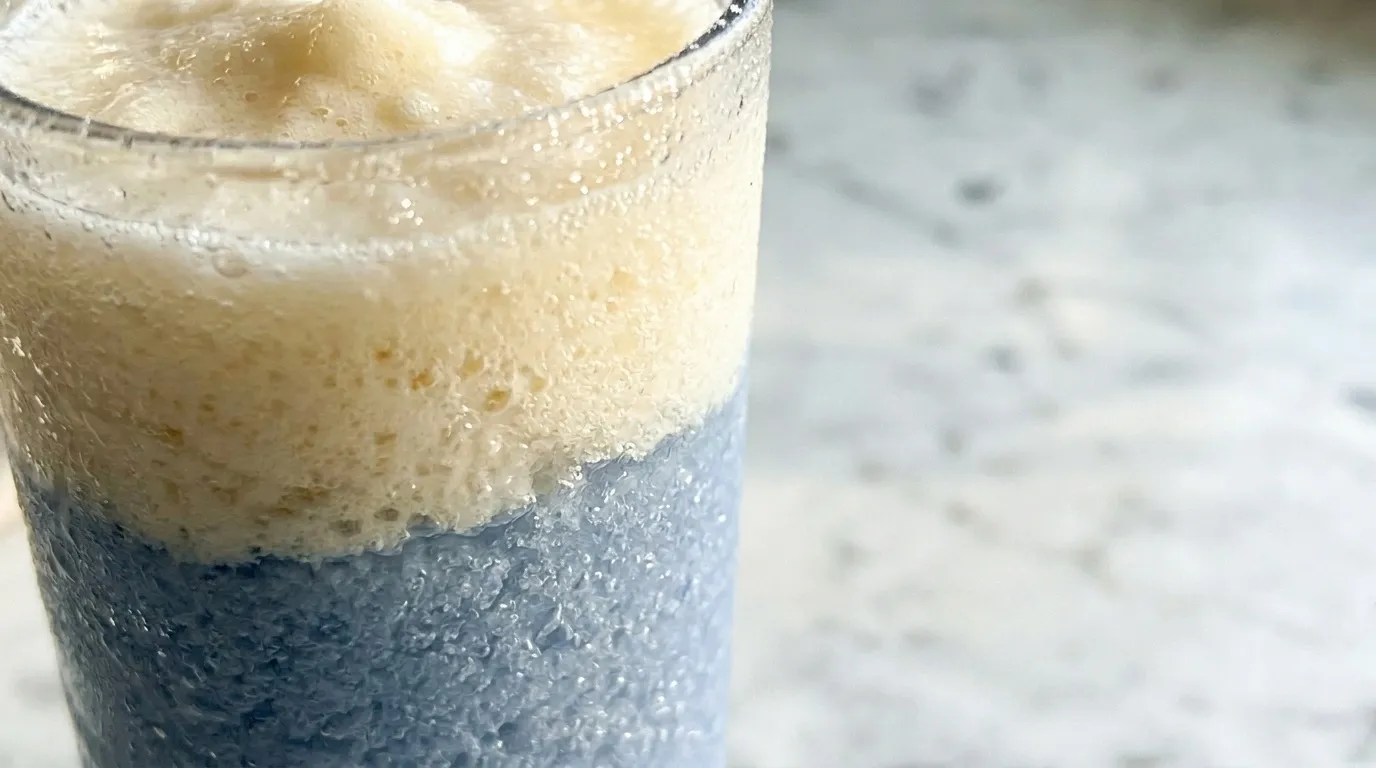
I picked up the glass. It was cold. Not refrigerator-cold — this was a cold that came from somewhere deeper, cellular, as if the liquid itself was temperature and the glass was just transportation. Condensation appeared on the surface immediately, a fine mist of tiny droplets that caught the low cantina light and made the glass look frosted. I watched a single bead of moisture form at the rim, pause, and track a slow line down to the bar, where it pooled into a tiny ring on the stone surface. I watched this happen for longer than was socially appropriate.
“It’s not going to drink itself,” Priya said.
I took a sip.
I need to be honest — I almost cried. In a cantina. On Tatooine. In front of Wuher, who I’m sure has a policy about crying.
The first thing was the cold. Not just temperature-cold but mineral-cold, clean, the way glacier water is cold in a way that tap water can never be. Then the sweetness, but not sugar-sweetness — something rounder, almost floral, with a nuttiness underneath that reminded me of almonds or macadamia or something I couldn’t name because it probably doesn’t grow on Earth. Then coconut. Unmistakable. Rich and fatty and grounding, the thing that made the whole drink feel like sustenance rather than refreshment. And underneath all of it, threaded through like a secret, something tropical — pineapple, maybe, or something adjacent to pineapple, something bright and acidic that lifted everything else and kept it from being too heavy.
It tasted like hope. I know that’s a ridiculous thing to say about a glass of milk. I know. But I watched that binary sunset in 1998 on the orange carpet in my parents’ living room, and what I felt was hope — hope that the world was bigger than my town, bigger than my life, bigger than the things I could see from where I was sitting. And this milk tasted like that exact feeling, blue and cold and impossibly far from everything ordinary.
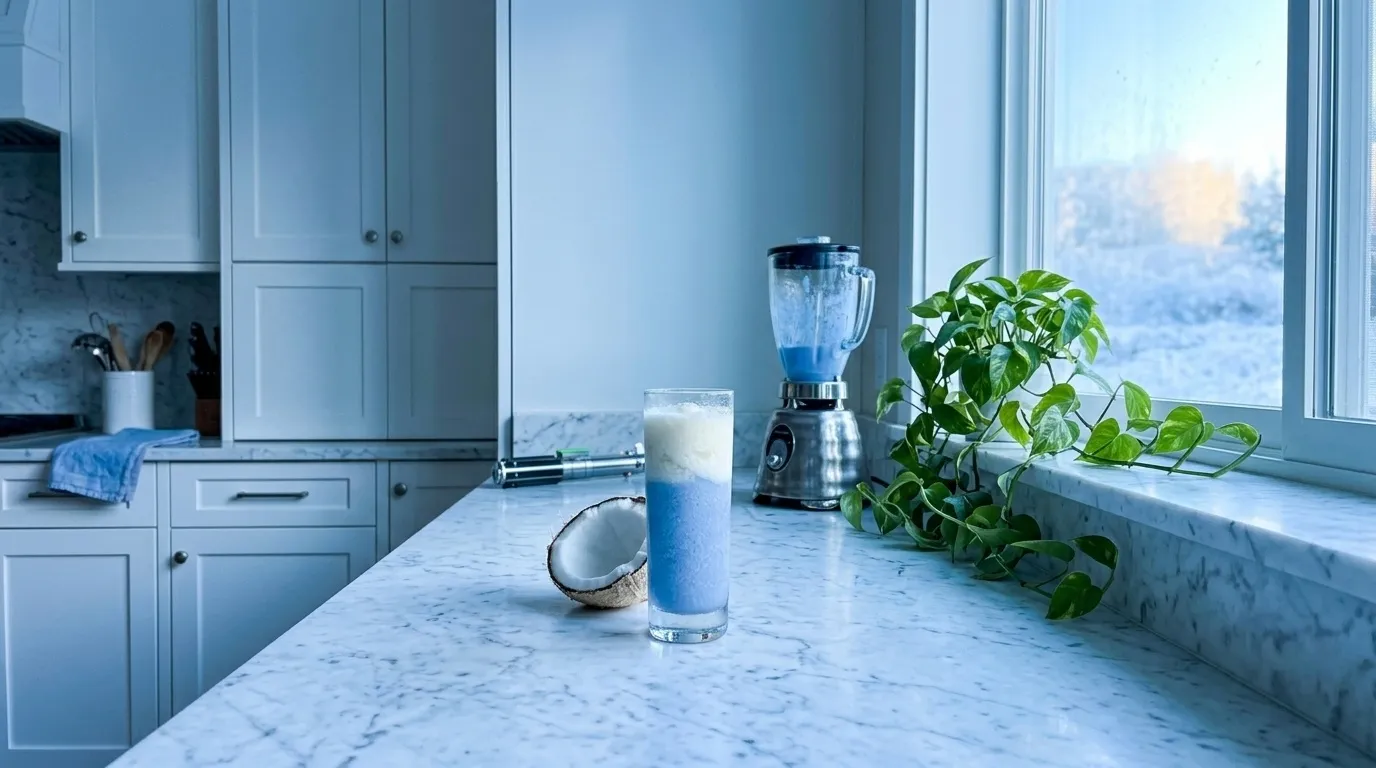
Priya took a long sip, set her glass down, and said: “Okay. That’s very good.”
From Priya, this is the equivalent of a standing ovation.
Wuher was watching us. Not watching, exactly — observing, the way a lizard on a rock observes. He’d stopped wiping the glass. “First time,” he said. Again, not a question.
“Is it that obvious?” I asked.
He looked at the expression on my face. “Yeah,” he said, and went back to wiping.
I spent six weeks trying to rebuild this drink. Six weeks, four trips to the Asian grocery for coconut cream, a blender motor that I burned out and had to replace (it was the old blender, the one Mark bought before we were married — he said “it served us well” as if it had died, and I held a small, private funeral in my heart for it), and a blue curaçao situation that I need to tell you about.
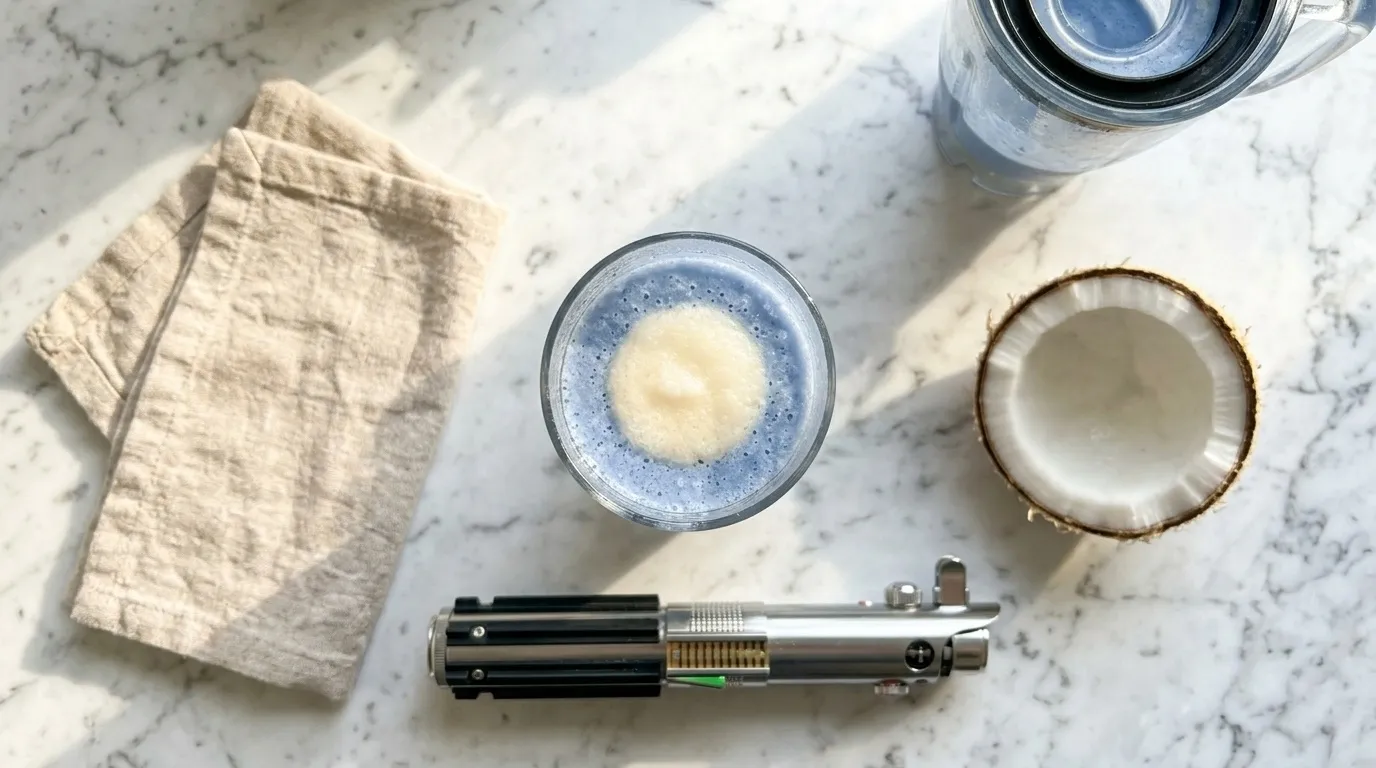
Blue curaçao is a complicated ingredient. Most people — most bartenders, even — treat it as food coloring that happens to be a liqueur. And with cheap blue curaçao, that’s basically what it is: artificially colored, sweet, vaguely orange-flavored, the mixological equivalent of a gel pen. But good blue curaçao — Senior Curaçao of Curaçao, specifically, the one actually made on the island with laraha peel — has genuine depth. Bitter orange on the nose. A dryness that counteracts the sweetness. An actual reason to exist beyond “makes things blue.” I tested three brands. The cheap one (which I won’t name but it comes in a bottle that looks like it should contain windshield washer fluid) made the drink taste like a melted popsicle. The mid-range one was fine but one-dimensional. The Senior was a different drink entirely — rounder, more complex, with a bitterness that played off the coconut cream the way lemon plays off butter.
The coconut cream nearly defeated me. Here is what I learned: not all coconut cream is coconut cream. Some of it is coconut milk with a label change. Some of it is coconut-flavored palm oil. What you want is full-fat coconut cream with a fat content above 20% — Aroy-D is my go-to, the one in the carton, not the can, because the carton version is pasteurized at a lower temperature and retains more of the fresh coconut flavor. When you open it, there should be a thick layer of solid cream at the top. That’s the good stuff. Spoon it out. That’s your white layer.
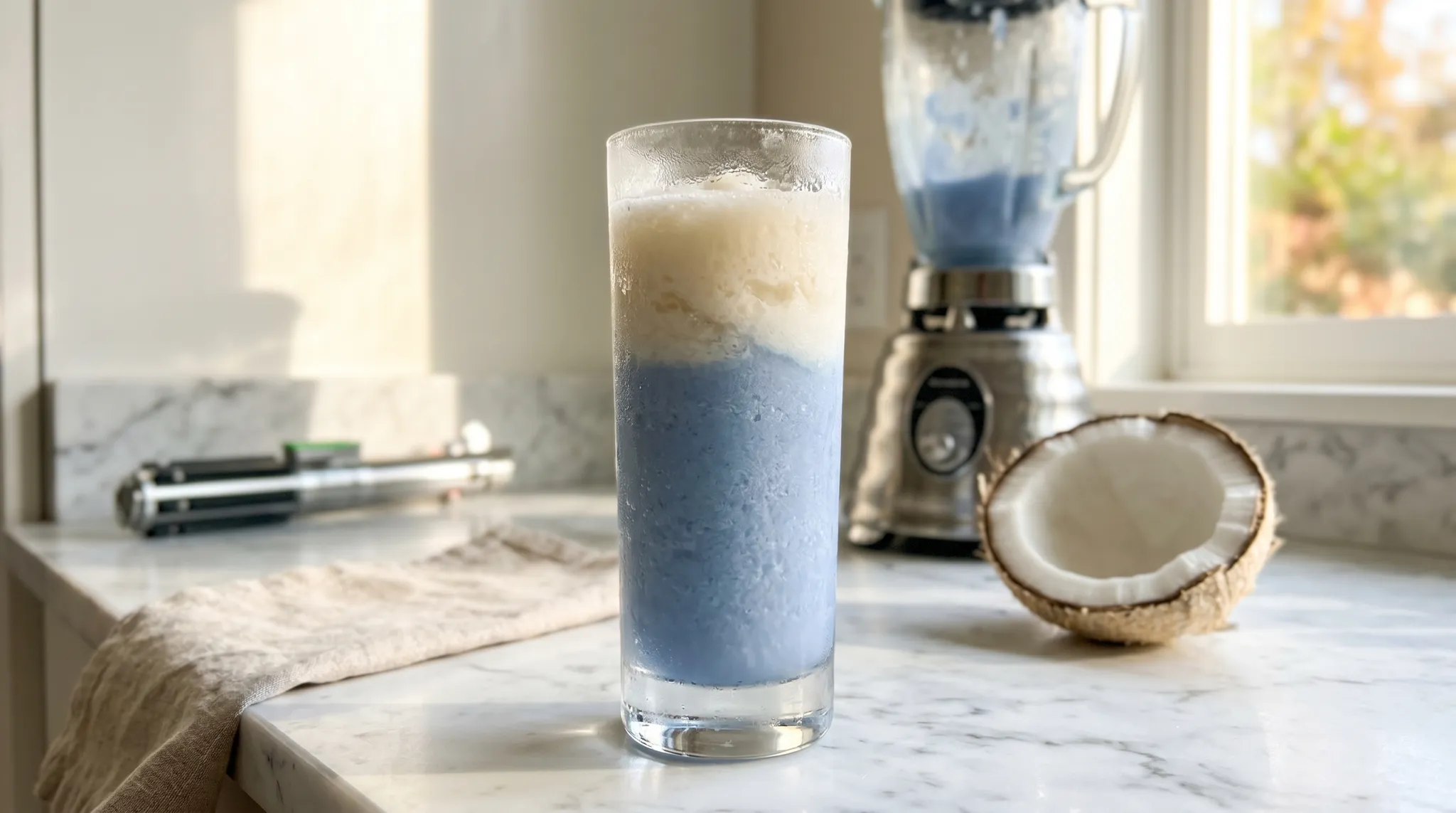
The layering was the thing that took the longest to master. In the cantina, the Blue Milk was a uniform color — no layers, just blue. But when I tasted it, I could feel the different components, the creamy top note and the brighter bottom note, and I realized that what Wuher served as a blended whole was actually two textures that happened to be mixed. My version separates them because it’s more beautiful and because it lets you experience the drink in stages: blue-tropical on the bottom, white-creamy on the top, and the magic zone in the middle where they meet and become something new.
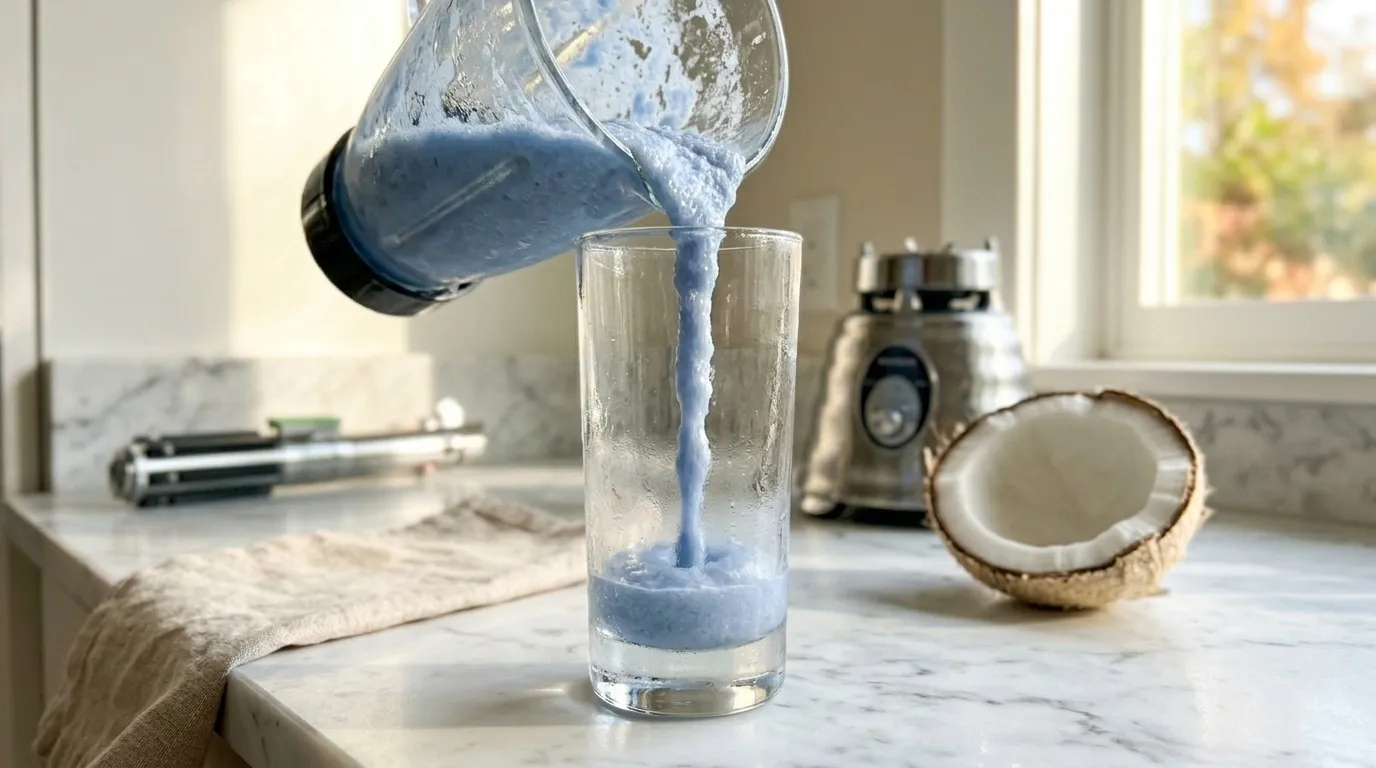
The secret to clean layers is density and temperature. The blue layer — coconut rum, blue curaçao, pineapple juice, ice — blends thinner and denser. The white layer — coconut cream, orgeat, vanilla, ice — blends thicker and lighter. Pour the blue first, then the white on top using the back of a spoon, and the density difference keeps them separate. But here’s the thing nobody tells you: the blue layer needs to be colder than the white layer. If they’re the same temperature, they mix on contact. I blend the blue layer with more ice and let it sit for thirty seconds before pouring. Then the white goes on top, barely blended, still thick. The temperature differential creates a barrier. Physics is on your side. Trust it.
The orgeat was my addition — it’s not in the original. Orgeat is an almond syrup used in tiki cocktails, and it adds a nuttiness that mimics the flavor I couldn’t identify in the cantina. I use Small Hand Foods orgeat, which is made with real almonds and has a marzipan quality that rounds out the coconut. A half ounce is enough. More than that and it gets cloying. Less and you lose the depth.
I’m going to tell you something that might sound dramatic, but I need you to hear it: this drink fixed a specific problem in my life. Not a big problem. Not a clinical problem. Just the small, persistent problem of being a grown woman who has spent twenty years wondering what a blue liquid from a movie tastes like and knowing that the wondering is absurd but not being able to stop. Now I know. It tastes like cold mornings and tropical afternoons and a farm boy looking at the horizon and believing there’s something out there worth finding. It tastes like the feeling you had before you learned the word “nostalgia” but after you learned the feeling.
Make this for a summer afternoon. Make this for a movie night. Make this for the person in your life who always picks the window seat and looks out of it a little too long.
Did you make this? I want to see your Binary Sunset. Show me the layers. Show me the blue. Tell me if you cried in your kitchen, alone, over a glass of something that shouldn’t exist but does. I want to know I’m not the only one.
Binary Sunset (Blue Milk)
Ingredients
Instructions
- Combine the coconut rum, blue curaçao, pineapple juice, and half the ice in a blender. Blend until smooth. You want the consistency of a thin smoothie — still pourable, not a slushie.
- Pour the blue mixture into a tall glass, filling it about two-thirds full. Let it sit for thirty seconds. This is not optional. The resting is load-bearing. (Priya would want me to use that term correctly.)
- Rinse the blender. Add the coconut cream, orgeat, vanilla extract, and remaining ice. Blend until smooth but thick — thicker than the blue layer, noticeably so.
- Layer the white mixture on top of the blue by pouring slowly over the back of a spoon. Patience. Patience is the Force, here. Let it flow.
- Do not stir. Let the layers remain distinct like the twin suns at sunset. The beauty is the boundary.
- Contemplate your destiny while drinking. Gaze at a horizon. Any horizon will do.
Magnolia’s Notes
-
On the layering: This is the whole game. If you pour the white layer too fast, you’ll get a murky purple-blue situation that, while still delicious, looks less like “galactic hope” and more like “something went wrong in hyperspace.” Pour over the back of a spoon — a regular dinner spoon, held upside down, barely touching the surface of the blue layer. Go slowly. Slower than you think. The kind of slow where you start to feel silly. That’s the right speed. Freeze the glass beforehand if you want extra insurance — the frost keeps the blue layer colder and denser, which makes the separation more dramatic.
-
On the coconut cream: Full-fat, full-fat, full-fat. I cannot stress this enough. When you open the carton or can, there should be a solid layer of thick white cream at the top. Spoon that out — that’s what you’re using. The watery liquid underneath is coconut water and it will ruin your white layer if you include it. Aroy-D in the carton is my standard. If you can only find cans, refrigerate them overnight and open from the bottom — the cream will have separated to the top (now the bottom) and you can drain the water first. This is the kind of thing I test at midnight so you don’t have to.
-
On the blue curaçao: I know it has a reputation. I know. Blue curaçao is the clip-art of the cocktail world and I am asking you to trust me anyway. Senior Curaçao of Curaçao — the one actually made on the island of Curaçao from laraha peel — is a genuinely good liqueur that happens to be blue. It has bitter orange depth, it has complexity, it has a reason to exist. The cheap stuff will still make a blue drink but it’ll taste like a blue drink instead of tasting like Tatooine.
-
On the orgeat: This is the secret ingredient — the thing that bridges the gap between “a blue coconut cocktail” and “something that tastes like it came from another world.” Orgeat is almond syrup, traditionally used in Mai Tais and other tiki drinks, and it adds a nutty, marzipan-like quality that mimics the unidentifiable depth I tasted in the cantina. Small Hand Foods is the gold standard. BG Reynolds is a solid second. Do not use the stuff that comes in the plastic squeeze bottle from the grocery store baking aisle — that’s almond extract with sugar and it will taste like the inside of an amaretto cookie, which is not what we’re doing here.
-
On serving temperature: This should be cold. Not cool, not room temperature, cold. Freeze the glass for at least thirty minutes beforehand. Use more ice rather than less. The frost on the outside of the glass isn’t just aesthetic — it’s a temperature indicator, a visual promise that the first sip will hit your throat the way a desert dweller needs it to. If it’s not cold enough to make you close your eyes on the first sip, add more ice next time.